
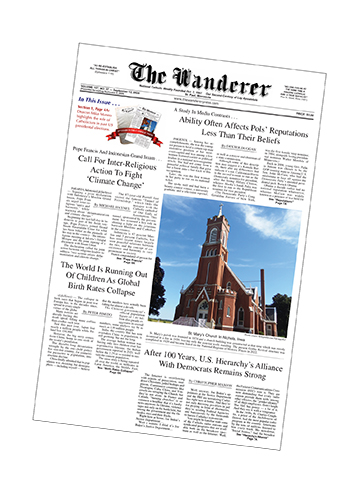
A Brief History In Our 159th Year Of
The Catholic Press
A Look Back And Ahead . . .
Under the editorship of
Joseph Matt (the present publisher’s great grandfather), Der Wanderer
was instrumental in promoting the principles of the Church’s social teaching
as set forth in Pope Leo XIII’s great encyclical, Rerum Novarum. The
paper was supportive of labor unions which organized with a sense of
solidarity among their members, who usually belonged to a specific craft or
trade. On the other hand, it was skeptical of the large industrial unions
which often promoted their objectives with appeals to class conflict and
ideology — an approach rejected in the social encyclicals.
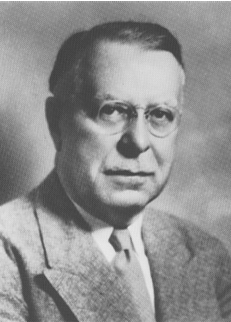
In 1931 Der Wanderer was joined by The Wanderer published in English, and the two journals published concurrently until 1957 when the German language Der Wanderer ceased publication. During the 1930s and 1940s, Wanderer editors were much involved in the growing liturgical movement in the United States led by Dom Virgil Michel, O.S.B., of St. John’s Abbey in Collegeville, Minnesota. As the world watched the rise to power in Germany of Adolf Hitler with fear and fascination, The Wanderer was among the first to denounce Nazism as totalitarian and antithetical to Christian principles. In September of 1933, the newspaper was barred from Germany where it reached some 1,200 readers. During World War II, its editor, Joseph Matt, monitored the course of the war each week, and published a series of brilliant and penetrating analyses of the long range geopolitical effects of what he saw as an unholy alliance between the Western powers and Communist Russia. He rightly predicted the move by Josef Stalin to expand Soviet hegemony as Nazi power was crushed and the West hesitated to challenge the Soviets. Not surprisingly, as the war drew to a close in 1945, the official Soviet newspaper, Pravda, demanded that the U.S. government suppress The Wanderer “for urging the Allies to make war on the Soviet Union or expel her from the United Nations.”
Reflecting
upon the 125 years of The Wanderer’s history in 1992, Al Matt Jr.
(current publisher’s father) while pondering this journal’s future, realized
that the challenges that lie ahead are no different fundamentally from those
which have marked not only The Wanderer’s past but the two thousand
year history of the Church.
Over sixty years ago, in a commentary appearing in the first issue in
English of The Wanderer, (the present writer’s great-grandfather),
editor Joseph Matt, assessed the mood of society as war clouds gathered and
the world lurched into the Great Depression.
“The
present crisis,” he declared, “is not an upshot of a temporary
disarrangement, but the logical consequence of conditions created by wrong
ideas that have prevailed too long and urgently demand a thorough
reconstruction of our social order on the foundation of solidarity, under
the lodestars of justice and charity.”
And what were those wrong ideas? Joseph Matt’s words are as descriptive of
today’s disordered world as they were of the world in 1931:
“Our age inclines to superficiality. It does not care to be bothered with
principles. It does not believe in unchangeable laws and principles. It
prefers to believe with Rousseau in the social contract, in the right of
every age and every generation to set up standards of its own. It is
satisfied with makeshifts, leaving it to posterity to be burdened with the
consequences of the foolishness and stupidity of preceding generations.
“This has been a characteristic of every age since Liberalism came into
power. It has been a characteristic of our own country for many years, no
matter what party had the majority.”
Vatican II And After
The Wanderer‘s long history and “institutional memory” served it well
with the opening of the momentous Second Vatican Council and the generation
that has since followed. Breaking the Church out of what some observers
termed a “siege mentality” into a fresh approach to evangelization and
dialogue with the world, the council unleashed both positive and destructive
energies. The Wanderer itself suffered from the divisions and
upheavals following the council. In 1967 editor Walter Matt left the
newspaper over a dispute about the meaning of Vatican II. He saw it not so
much as a reform and a renewal of the Church but as a revolution that
threatened to undermine the Church herself. His brother, Alphonse J. Matt,
Sr. (the present writer’s grandfather), took over the reins at The
Wanderer and reminded its readers that the real intent of the council
was a renewed evangelization of the world for Christ and a personal renewal
of every individual Catholic.
For The Wanderer, the council was not a rejection or an abandonment of tradition, but a development of that tradition, safeguarded for 2,000 years by the Holy Spirit, to better enable the Church to continue to bring the Gospel to all men. The years since the council were turbulent ones both for the Church and The Wanderer. A spirit of dissent, experimentation, and innovation pervaded many members of the clergy, religious, and theologians. The effects on catechetics, liturgy, and traditional Catholic practices were significant. Even bishops were divided in their views of the council. The single most divisive issue in the postconciliar Church was that of contraception (brought into sharp focus with the development of the “Pill” in the early 1960s), and it created renewed and controversial debates on sexuality. Pope Paul VI met this challenge and hoped to resolve the problem with the encyclical Humanae Vitae. The Wanderer was unyielding in its defense of that encyclical and helped to mobilize support for Humanae Vitae by joining some other Catholic leaders in organizing Catholics United for the Faith.
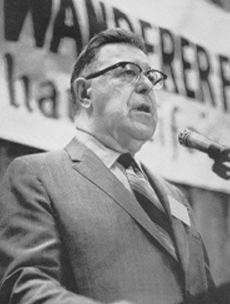
The post-conciliar years were marked by debate over liturgy, doctrine, and Church authority. The Wanderer consistently defended traditional teachings while engaging contemporary issues.
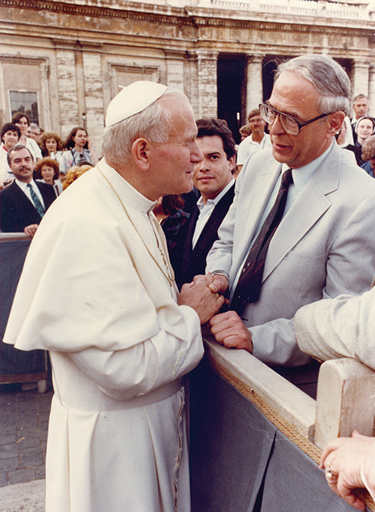 Saint John Paul ll - Al Matt Jr.
Under Al Matt Jr., the paper addressed controversies including liturgical reforms and theological dissent, often taking strong editorial positions.
The single most divisive issue in the postconciliar Church was that of contraception... The Wanderer was unyielding in its defense of Humanae Vitae and helped to mobilize support for it by joining some other Catholic leaders in organizing Catholics United for the Faith.
The Wanderer
found itself more and more in opposition to the theologians, clerics,
religious, and bishops who used the council as the pretext for advancing new
and untraditional programs. The newspaper was a vigorous opponent of the
Call to Action Program in 1976 which threatened to loosen the ties of the
Church in the United States to the Vatican and to focus on social change
with a leftwing bent. Some new catechisms, liturgies, and scriptural
theories were frequent targets of The Wanderer‘s writers and
editorialists.
Al Matt Jr.’s
lengthy tenure with The Wanderer coincided with the era of dissent
following the close of the Second Vatican Council.
The revision of the rite of the Sacrifice of the Mass ordered by Pope Paul
VI after Vatican II created divisions among Catholics. While The Wanderer
did express some reservations about the extent and character of the reforms,
the editors defended the authority of Paul VI over the liturgy. This stance
led thousands of readers to end their subscriptions — not the last time
The Wanderer would lose subscriptions over a controversial editorial
position!
The revision of the rite of the Sacrifice of the Mass ordered by Pope Paul
VI after Vatican II created divisions among Catholics. While The Wanderer
did express some reservations about the extent and character of the reforms,
the editors defended the authority of Paul VI over the liturgy. This stance
led thousands of readers to end their subscriptions — not the last time
The Wanderer would lose subscriptions over a controversial editorial
position!
Many of those lost
subscribers pointed to widespread abuses in the liturgy as the reason for
their rejection of the Second Vatican Council and the Novus Ordo. The
Wanderer reported extensively on episodes of those abuses, calling on
the bishops to act to end liturgical experimentation and disobedience. This
was a frequent subject of Al Matt’s editorials.
For example, in the May 17, 2001 Wanderer, he wrote an editorial entitled, “The Bishops Can End Our Liturgical Nightmare,” in which he welcomed Liturgiam Authenticam, the Vatican’s fifth instruction “For the Right Implementation of the Constitution on the Sacred Liturgy of the Second Vatican Council.”

He wrote: “While The Wanderer properly accepted Pope Paul VI’s
promulgation of the Novus Ordo Mass, this journal also accepted the
principles of translation into the vernacular insisted upon by Pope Paul VI
and the council fathers. That these principles have not been followed — even
that most fundamental one that the underlying theology of the Latin texts
must be evident in the translation — has filled hundreds of The Wanderer’s
pages during the last 30 years.”
“Now, The Wanderer is a leader in promoting the reforms of
Summorum Pontificum, Pope Benedict XVI’s 2007 motu proprio
allowing for wider use of the Traditional liturgy. Its many columnists and
contributors are hailing the advent of the new, corrected translation in the
United States.”
The newspaper has also highlighted the Pope’s 2009 apostolic constitution
Anglicanorum Coetibus, providing personal ordinariates to enable
Anglicans to enter the Catholic Church, and his 2009 encyclical Caritas
in Veritate, which explains how charity in truth is at the heart of the
Church’s social teaching. Also under Al Matt Jr.’s leadership, The
Wanderer has continually and forcefully defended Catholic teaching and
discipline on marriage and the sanctity of life against the onslaught of
critics, whether within or without the Church. Throughout the pontificates
of Pope John Paul II and Pope Benedict XVI, The Wanderer has espoused
those Popes’ magnificent teachings on these vital issues.
The Wanderer
continued its vital role in the Catholic press under the editorship of Peggy
Moen who spent over 30 years as our associate editor. It was only fitting
that she be given the role as editor when then editor Al Matt Jr.,
retired in 2014. Because of her able and broad experience she was a natural
to fulfill that role. Her ability to measure the pulse and importance of the
issues of the day was second to none and the Wanderer continued to
fulfill its purpose through her editorship up until her retirement in the
Spring of 2024. To this day
The Wanderer remains the oldest independent national Catholic newspaper
in America. We are loyal to the Magisterium of The Catholic church and
committed to providing our readership with news, commentary, and catechesis
without compromising Catholic orthodoxy.
Joseph Matt – Editor, Publisher