
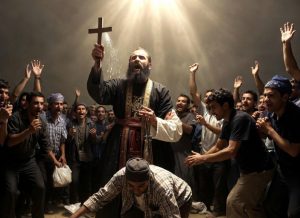
A Leaven In The World . . . Exorcists Spreading Dangerous Private Revelation
Of the many aberrations spawned in the instability and confusion of the post–Vatican II era, the promotion of private revelation has to be one of the most dangerous. One can find many overexposed priests on social media and YouTube. The pope has been among the many who have warned them of the danger of this path.
A priest in Italy recently left the priesthood after he met a woman by means of the many images of himself shared on the internet and struck up an exclusive relationship with her.
Sometimes the same leaders who decry the lack of catechesis and resulting ignorance of the faith on the part of so many are the same ones who spend an inordinate amount of time drawing attention to themselves and their experiences, supernatural and otherwise.
Among these are exorcists whose recounting of strange otherworldly events provide diverting spectacles and frightening stories that certainly draw a lot of attention and scare a number of people. But to what end?
A self-described exorcist priest frequently likes to entertain a roomful of his fellow clergy at a gathering or galvanize the attention of a young priest of his acquaintance with fantastic tales of evil spirits and their doings.
When challenged about his near-monomaniacal obsession with discussing these spiritual and private events nonstop in public, he claims that it will be for the good end of scaring people into practicing their faith, “since nothing else is working” in this age of shrinking congregations and closing churches.
Just another tradition replacement like so many others, as “nature abhors a vacuum”? Or something more dangerous?
Christ ordered the demons not to speak, as recorded in Matthew. Should priest-exorcists then be giving them a voice?
“And they went into Capernaum; and immediately on the sabbath he entered the synagogue and taught. And they were astonished at his teaching, for he taught them as one who had authority, and not as the scribes.
“And immediately there was in their synagogue a man with an unclean spirit; and he cried out, ‘What have you to do with us, Jesus of Nazareth? Have you come to destroy us? I know who you are, the Holy One of God.’ But Jesus rebuked him, saying, ‘Be silent, and come out of him!’ And the unclean spirit, convulsing him and crying with a loud voice, came out of him.
“And they were all amazed, so that they questioned among themselves, saying, ‘What is this? A new teaching! With authority he commands even the unclean spirits, and they obey him.’ And at once his fame spread everywhere throughout all the surrounding region of Galilee” (Mark 1:21–28).
We know what the Lord teaches about supplanting His voice and teaching with the utterings of the Evil One and his minions. The sainted seers of the past, well-rooted in Catholic teaching, never presumed private revelations or apparitions were of God, and quite rightly suspecting they might be of the devil, would first reject and avoid them, leaving it to our Lady and the power of God to persist and provide proof of divine origin.
Thus, the spring discovered by St. Bernadette at Lourdes under the guidance of our Lady, and the tilma of Juan Diego at Guadalupe left as a sign that she indeed had appeared to him.
But the Church has always taught that the danger that a vision or voice might be from Satan meant that the safest route was to presume such and continue to lean on public Revelation and Church teaching so as never to do the least thing to jeopardize the great prize of salvation, the entire purpose of Christ, the Church, and the faith.
What does the Church say about the status and supposed importance of private revelations?
From the Catechism of the Catholic Church (CCC):
“There will be no further Revelation.
“ ‘The Christian economy, therefore, since it is the new and definitive Covenant, will never pass away; and no new public revelation is to be expected before the glorious manifestation of our Lord Jesus Christ’ (Dei Verbum, n. 4; cf. 1 Tim. 6:14; Titus 2:13). Yet even if Revelation is already complete, it has not been made completely explicit; it remains for Christian faith gradually to grasp its full significance over the course of the centuries.
“Throughout the ages, there have been so-called ‘private’ revelations, some of which have been recognized by the authority of the Church. They do not belong, however, to the deposit of faith. It is not their role to improve or complete Christ’s definitive Revelation, but to help live more fully by it in a certain period of history. Guided by the Magisterium of the Church, the sensus fidelium knows how to discern and welcome in these revelations whatever constitutes an authentic call of Christ or his saints to the Church.
“Christian faith cannot accept ‘revelations’ that claim to surpass or correct the Revelation of which Christ is the fulfillment, as is the case in certain non-Christian religions and also in certain recent sects which base themselves on such ‘revelations. . . .’
“By love, God has revealed himself and given himself to man. He has thus provided the definitive, superabundant answer to the questions that man asks himself about the meaning and purpose of his life.
“God has revealed himself to man by gradually communicating his own mystery in deeds and in words.
“Beyond the witness to himself that God gives in created things, he manifested himself to our first parents, spoke to them, and, after the fall, promised them salvation (cf. Gen. 3:15) and offered them his covenant.
“God made an everlasting covenant with Noah and with all living beings (cf. Gen. 9:16). It will remain in force as long as the world lasts.
“God chose Abraham and made a covenant with him and his descendants. By the covenant God formed his people and revealed his law to them through Moses. Through the prophets, he prepared them to accept the salvation destined for all humanity.
“God has revealed himself fully by sending his own Son, in whom he has established his covenant forever. The Son is his Father’s definitive Word; so there will be no further Revelation after him” (CCC, nn. 66–73).
Nothing replaces the work of the priest and his collaborators in teaching the matters of public Revelation that make up our revealed Catholic faith. Scripture and Tradition cannot be replaced or supplanted by any other information.
Diversions into recounting the strange and frightening visions and voices priests see and hear during the conduct of their work of exorcism might serve to be very entertaining but can be dangerous. And for that reason should not be shared.
As well, we do not need exorcists to tell us that demons have revealed that some of the Catholic Church’s leadership is “very morally compromised, and some of it is involved in stuff that’s very dark,” as was revealed in a recent episode on one of the many YouTube channels run by practicing Catholics.
We, unfortunately, already know this to be true without the corroboration of demons. What is the point of saying such? Perhaps to draw attention to the person saying it? I cannot know for sure, but priests, and exorcists above all, should shun every opportunity to draw attention to themselves.
If anything gives entrance to the Evil One it is pride in its many insidious forms. Pride was the sin of Lucifer who was not content to be a creature and refused to serve God in the great rebellion that continues to draw others to hell in his wake.
I would say that a self-advertising exorcist is a clear and present danger to himself and others and should, for his own good, be promptly reassigned other work far from the glare of publicity.
Humility can be a hard and bitter penance, but nothing is more precious than eternal salvation as many exorcists themselves would be quick to avow.
Thank you for reading. Praised be Jesus Christ our King, now and forever.
apriestlife.blogspot.com
