

LatestNews

By JAMES MONTI , Latest

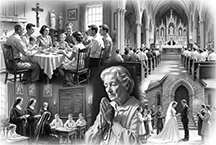
RESTORING THE SACRED . . . Glimpses Of Catholic Life From The 1950s

The history of our Catholic faith that has spanned nearly 2,000 years is an unending story of the loving Providence of God in the lives of countless souls. This story has been preserved
By Dr. CHRISTOPHER MANION , Latest

On Giving, Getting, And Government

The Washington Post, now known as the “Bezos Blog,” recently ran an interesting headline: “Retirees receive six times more in federal dollars than young people.” We apologize for the Post, that serves as
By Fr. KEVIN CUSICK , Latest

A Leaven In The World . . . Rest In Peace, Noelia

In the midst of the Easter Season, with the Resurrection of the Lord at the center of our prayer and worship, we mourn the increasing tide of the cult of death. Faith in
By JAMES MONTI , Latest

RESTORING THE SACRED

Holy Week In Corsica The Mediterranean island of Corsica is a culturally unique place with a largely French modern history but with a considerable Italian past. Its Holy Week customs are deeply rooted
By Dr. CHRISTOPHER MANION , Latest

‘Hey, So What? That’s Old News!’

That was the slogan of Bill Clinton’s ace defender James Carville when one after another of the rapist’s crimes came across the screen. It worked, and the next generation of Democrats has now
By DONALD DEMARCO , Latest

Ethics And Language

A language develops in mysterious ways. How it emerges from grunts and groans to the highly complex and intricate web of meaning eludes scientific explanation. Nonetheless, what is known is that it develops
By JAMES DRUMMEY , Latest

Catholic Replies

Question. If I dream that I killed someone, would God consider that a sin? — J.B., Pa. Answer. No, we are not morally responsible for sinful actions that occur in dreams. The only
By Fr. KEVIN CUSICK , Latest

A Leaven In The World . . . Exorcists Spreading Dangerous Private Revelation

Of the many aberrations spawned in the instability and confusion of the post–Vatican II era, the promotion of private revelation has to be one of the most dangerous. One can find many overexposed
By Dr. CHRISTOPHER MANION , Latest

The Plight Of The Illegal Immigrant

The immigration debate that rages in the United States and Western Europe today focuses on the impact of immigrants, both legal and illegal, in their countries of destination. In order better to understand
By Fr. KEVIN CUSICK , Latest

A Leaven In The World . . . Don’t Get Distracted From The Real War

The Catholic commentariat, in the wake of the opening salvos of the war in Iran, has, if you’ll forgive the pun, exploded. Many voices are untethered from Catholic just-war and social teaching. Some

RESTORING THE SACRED . . . Glimpses Of Catholic Life From The 1950s

RESTORING THE SACRED . . . Glimpses Of Catholic Life From The 1950s

The history of our Catholic faith that has spanned nearly 2,000 years is an unending story of the loving Providence of God in the lives of countless souls. This story has been preserved and handed down to us in many forms, from stone carvings and artwork to medieval manuscripts.

In more recent times, the advent of periodicals, facilitated by the development of the printing press, introduced a new means of recording key moments in the life of the Church as well as the legacies of individual Catholics who by their examples of faith and courage have left an enduring mark upon the history of our faith.

Some months ago, in my job as a library clerk at a major seminary, I was asked to do research in the pages of New York’s former archdiocesan newspaper, The Catholic News, from the 1950s, preserved on microfilm rolls. This assignment has proved to be an amazing experience in that it has opened up for me a huge vista of the vibrancy of the Catholic faith in the United States and elsewhere in the 1950s. This experience has proven to be distinctly different from my earlier work with Catholic academic journals of the 1950s in which the early stages of the unhappy theological revolt of the 1960s could be discerned.

By contrast, the Catholic newspaper and news service stories I have encountered reveal the faith as it was actually being lived by rank-and-file Catholic clergy, religious, and laity as yet untainted by the novelties of heterodox theological speculation. The picture that emerges is one of a Church that in so many ways was thriving.

Here I would like to share with Wanderer readers a sampling of the vignettes of Catholic life in the early 1950s that have come to light in exploring some of the Catholic newspaper resources from this period.

On Jan. 16, 1953, an Aer Lingus Dakota airliner bound for Elmdon Airport in Birmingham, England, was nearing the end of its journey with 22 passengers and three crewmembers when one of its two engines failed and the second engine began to stall. As the pilot and copilot wrestled with the question of where to steer a plane that was doomed to crash, the airliner’s 23-year-old stewardess Philomena McCloskey immediately recognized what the passengers needed most at that crucial moment that would decide their fate.

Exiting the cockpit, she knelt down in the plane’s center aisle and calmly announced to the passengers, “I think we should pray now.” She began by leading the passengers in the recitation of an Act of Contrition, after which she began the Rosary.

As the passengers prayed with Philomena, the pilot and copilot spotted a farm field that seemed to offer at least a slim hope for a survivable crash. As the plane descended and hit the ground, it skidded through two hedges and across the rough terrain of the farm field until it rammed into a tree, losing one wing, both engines, and its tail section along the way.

When the destroyed plane finally came to a stop, Philomena looked about and saw that all 22 passengers had survived unhurt. The pilot too was fine, and the copilot had suffered only a minor injury.

When afterward a British Civil Aviation Ministry official came to inspect the crash, he observed, “It was a miracle no one was killed” (N.C.W.C. News (Foreign) Service, Jan. 19, 1953, p. 5).

Around six in the morning on Nov. 12, 1952, an aged waterfront worker named Charles Gill collapsed and died with a Rosary in his hands shortly after exiting the Church of St. Alphonsus near Manhattan’s Canal Street.

This little-known man was no stranger to the Redemptorist priests who staffed St. Alphonsus Church where, each day following the completion of his grueling nocturnal shift as a waterfront night picker, Gill would arrive at 4 a.m. to begin two hours of prayer and penance for the relief of the holy souls in Purgatory, a spiritual work of mercy that he had been carrying out faithfully every day for 15 years. It had been likewise his daily routine to precede the beginning of his night shift with a second late-afternoon round of prayer for the holy souls at the Redemptorists’ church.

His funeral was attended by very few apart from the priests who knew him, but one can well imagine the reception he received in the next life from the many souls whose ordeals in Purgatory he had shortened by his prayers on earth (“Waterfront Worker Who Spent Life in Prayer for Holy Souls Is Dead,” Catholic News, Nov. 29, 1952, p. 19).

At Pottsville, Pa., a coal miner named Sylvester Prosper suddenly found himself buried up to his neck in a mine shaft during strip mining work. Among the first to reach him by crawling through the 40-foot mine shaft was Fr. John Shellum, intent upon giving the Last Rites to the trapped man and to do what he could to save his life. The priest began digging with a shovel together with rescue workers and succeeded in extricating the miner ten hours after his ordeal began (“Priest Risks Life to Give Last Rites, then Digs Man Out”, Catholic News, Dec. 27, 1952, p. 18).

Catholics in New York City were able to end the year of 1952 by attending one of two Eucharistic Holy Hours at St. Patrick’s Cathedral on New Year’s Eve, the first at 8 p.m. and the second at 11 p.m., each preceded by a half-hour of Christmas carols and each ending with solemn Benediction given by New York Auxiliary Bishop Joseph Flannelly (“New Year ‘Holy Hours’ Are Held at Cathedral,” Catholic News, Jan. 3, 1953, p. 24).

At St. John’s Hospital in St. Louis, around 40 obstetricians, including many non-Catholic physicians, attended an annual Mass of Thanksgiving to express their gratitude that for the fourth year in a row at the Catholic medical facility none of the over 2,400 birthing mothers under their care had died during childbirth (Catholic News, Jan. 24, 1953, p. 12).

In Bellefonte, Pa., inmates began a prison uprising at the Rockview Penitentiary that continued unabated for four days, with seven prison guards taken hostage. The prisoners had managed to arm themselves with seven pistols and a box of teargas bombs.

It was the Catholic chaplain of the prison, Fr. Richard Walsh, who brought the siege to an end by climbing a ladder up the prison wall to speak with the four ringleaders of the inmates’ revolt. Fr. Walsh later related, “I pointed out the grave danger of unnecessarily exposing their lives and the lives of the hostage guards. They thought it over and finally agreed to go along.” They told the priest, “Father, we’ll give you our guns and release the guards” (“Priest Persuades Rioting Prisoners to End Rebellion,” Catholic News, Jan. 31, 1953, p. 13).

In the Feb. 28, 1953, issue of New York’s Catholic News is mention of a group of almost 50 New York City government employees who would recite during their lunch hour two public Rosaries daily in Queens Borough Hall, with the first Rosary at 12:45 p.m. and the second at 1 p.m., both said in the conference room of the borough president. At the time, the custom had been going on for four years (Catholic News, Feb. 28, 1953, p. 16).

Four months earlier, on Oct. 1, 1952, Bishop Flannelly had celebrated a Mass in the Lady Chapel of St. Patrick’s Cathedral that he offered for the intentions of an intrepid group of Catholic business workers who since October of 1950 had faithfully gathered in the cathedral each working day at 1:10 p.m., during their lunch hour, to recite the Rosary together. Others working in the business district near the cathedral subsequently took up this practice, assembling at the cathedral at four other times of the day — at 12:45 p.m., 12:50 p.m., 4:45 p.m., and 5:10 p.m. — to pray the Rosary together (“Business Men of Midtown Manhattan Pray Rosary Daily at St. Patrick’s,” Catholic News, Sept. 27, 1952, p. 3).

The April 18, 1953, issue of New York’s Catholic News featured the deeply moving text of a Last Testament penned by the archbishop of Ottawa, Canada, Alexandre Vachon (1885–1953), which was read at his Requiem Mass, addressing the people of his archdiocese “from Purgatory,” as it were:

“They chant my funeral, but where am I? My body is there, stretched out, an inert mass in which corruption is already advanced. How many times, in this basilica-cathedral, in placing the ashes on the forehead of the faithful after having received them myself, I have said these words: ‘Memento, homo, quia pulvis es’. . . . ‘Remember, man, thou art dust, and unto dust thou shalt return.’ These words are fulfilled for me at this moment. . . .

“And my soul, where is my soul at this moment? It is in Purgatory, and there it will remain until it has totally satisfied for its faults and imperfections.

“My soul suffers. It must be pure to go to Heaven! It can do nothing for itself now, my dear spiritual children! Its future deliverance then depends upon you! It cries to you from the depths of its suffering: Have pity on me! . . .

“I beg you, come and pray at my tomb! Give my soul the alms of a fervent prayer, of a Mass celebrated or of a Mass heard, of some sacrifice, of a Rosary, of an ejaculatory prayer. . . .

“At this drear moment, my dear spiritual children, remember that you also will die, and perhaps soon. The only regret you will experience at the decisive moment of death will be that you have not done enough toward your salvation. Meditate on that. Avoid sin and the occasion of sin. Keep in the grace of God, in His love. Remember that you are dust, and that unto dust you shall return . . .” (“Archbishop Sends His People ‘Message from Purgatory’,” Catholic News, April 18, 1953, p. 6).

A May 1953 Catholic News story tells of a May crowning carried out by student nurses at St. Vincent’s Hospital in Manhattan, part of what was then a vast network of 20 Catholic hospitals within the Archdiocese of New York. The student nurses went in procession to the hospital’s terrace, where one of them crowned a statue of the Blessed Virgin. As loudspeakers broadcast the ceremony to patients throughout the hospital, a priest from a nearby church concluded the evening with Benediction of the Blessed Sacrament (“St. Vincent’s Hospital Holds Marian Ceremony,” Catholic News, May 23, 1953, p. 33).

In the weeks to come, I hope to share with Wanderer readers more of these simple stories from a time when Catholics readily manifested their faith in public, something we need now more than ever.

RESTORING THE SACRED . . . Glimpses Of Catholic Life From The 1950s

The history of our Catholic faith that has spanned nearly 2,000 years is an unending story of the loving Providence of God in the lives of countless souls. This story has been preserved and handed down to us in many forms, from stone carvings and artwork to medieval manuscripts.

In more recent times, the advent of periodicals, facilitated by the development of the printing press, introduced a new means of recording key moments in the life of the Church as well as the legacies of individual Catholics who by their examples of faith and courage have left an enduring mark upon the history of our faith.

Some months ago, in my job as a library clerk at a major seminary, I was asked to do research in the pages of New York’s former archdiocesan newspaper, The Catholic News, from the 1950s, preserved on microfilm rolls. This assignment has proved to be an amazing experience in that it has opened up for me a huge vista of the vibrancy of the Catholic faith in the United States and elsewhere in the 1950s. This experience has proven to be distinctly different from my earlier work with Catholic academic journals of the 1950s in which the early stages of the unhappy theological revolt of the 1960s could be discerned.

By contrast, the Catholic newspaper and news service stories I have encountered reveal the faith as it was actually being lived by rank-and-file Catholic clergy, religious, and laity as yet untainted by the novelties of heterodox theological speculation. The picture that emerges is one of a Church that in so many ways was thriving.

Here I would like to share with Wanderer readers a sampling of the vignettes of Catholic life in the early 1950s that have come to light in exploring some of the Catholic newspaper resources from this period.

On Jan. 16, 1953, an Aer Lingus Dakota airliner bound for Elmdon Airport in Birmingham, England, was nearing the end of its journey with 22 passengers and three crewmembers when one of its two engines failed and the second engine began to stall. As the pilot and copilot wrestled with the question of where to steer a plane that was doomed to crash, the airliner’s 23-year-old stewardess Philomena McCloskey immediately recognized what the passengers needed most at that crucial moment that would decide their fate.

Exiting the cockpit, she knelt down in the plane’s center aisle and calmly announced to the passengers, “I think we should pray now.” She began by leading the passengers in the recitation of an Act of Contrition, after which she began the Rosary.

As the passengers prayed with Philomena, the pilot and copilot spotted a farm field that seemed to offer at least a slim hope for a survivable crash. As the plane descended and hit the ground, it skidded through two hedges and across the rough terrain of the farm field until it rammed into a tree, losing one wing, both engines, and its tail section along the way.

When the destroyed plane finally came to a stop, Philomena looked about and saw that all 22 passengers had survived unhurt. The pilot too was fine, and the copilot had suffered only a minor injury.

When afterward a British Civil Aviation Ministry official came to inspect the crash, he observed, “It was a miracle no one was killed” (N.C.W.C. News (Foreign) Service, Jan. 19, 1953, p. 5).

Around six in the morning on Nov. 12, 1952, an aged waterfront worker named Charles Gill collapsed and died with a Rosary in his hands shortly after exiting the Church of St. Alphonsus near Manhattan’s Canal Street.

This little-known man was no stranger to the Redemptorist priests who staffed St. Alphonsus Church where, each day following the completion of his grueling nocturnal shift as a waterfront night picker, Gill would arrive at 4 a.m. to begin two hours of prayer and penance for the relief of the holy souls in Purgatory, a spiritual work of mercy that he had been carrying out faithfully every day for 15 years. It had been likewise his daily routine to precede the beginning of his night shift with a second late-afternoon round of prayer for the holy souls at the Redemptorists’ church.

His funeral was attended by very few apart from the priests who knew him, but one can well imagine the reception he received in the next life from the many souls whose ordeals in Purgatory he had shortened by his prayers on earth (“Waterfront Worker Who Spent Life in Prayer for Holy Souls Is Dead,” Catholic News, Nov. 29, 1952, p. 19).

At Pottsville, Pa., a coal miner named Sylvester Prosper suddenly found himself buried up to his neck in a mine shaft during strip mining work. Among the first to reach him by crawling through the 40-foot mine shaft was Fr. John Shellum, intent upon giving the Last Rites to the trapped man and to do what he could to save his life. The priest began digging with a shovel together with rescue workers and succeeded in extricating the miner ten hours after his ordeal began (“Priest Risks Life to Give Last Rites, then Digs Man Out”, Catholic News, Dec. 27, 1952, p. 18).

Catholics in New York City were able to end the year of 1952 by attending one of two Eucharistic Holy Hours at St. Patrick’s Cathedral on New Year’s Eve, the first at 8 p.m. and the second at 11 p.m., each preceded by a half-hour of Christmas carols and each ending with solemn Benediction given by New York Auxiliary Bishop Joseph Flannelly (“New Year ‘Holy Hours’ Are Held at Cathedral,” Catholic News, Jan. 3, 1953, p. 24).

At St. John’s Hospital in St. Louis, around 40 obstetricians, including many non-Catholic physicians, attended an annual Mass of Thanksgiving to express their gratitude that for the fourth year in a row at the Catholic medical facility none of the over 2,400 birthing mothers under their care had died during childbirth (Catholic News, Jan. 24, 1953, p. 12).

In Bellefonte, Pa., inmates began a prison uprising at the Rockview Penitentiary that continued unabated for four days, with seven prison guards taken hostage. The prisoners had managed to arm themselves with seven pistols and a box of teargas bombs.

It was the Catholic chaplain of the prison, Fr. Richard Walsh, who brought the siege to an end by climbing a ladder up the prison wall to speak with the four ringleaders of the inmates’ revolt. Fr. Walsh later related, “I pointed out the grave danger of unnecessarily exposing their lives and the lives of the hostage guards. They thought it over and finally agreed to go along.” They told the priest, “Father, we’ll give you our guns and release the guards” (“Priest Persuades Rioting Prisoners to End Rebellion,” Catholic News, Jan. 31, 1953, p. 13).

In the Feb. 28, 1953, issue of New York’s Catholic News is mention of a group of almost 50 New York City government employees who would recite during their lunch hour two public Rosaries daily in Queens Borough Hall, with the first Rosary at 12:45 p.m. and the second at 1 p.m., both said in the conference room of the borough president. At the time, the custom had been going on for four years (Catholic News, Feb. 28, 1953, p. 16).

Four months earlier, on Oct. 1, 1952, Bishop Flannelly had celebrated a Mass in the Lady Chapel of St. Patrick’s Cathedral that he offered for the intentions of an intrepid group of Catholic business workers who since October of 1950 had faithfully gathered in the cathedral each working day at 1:10 p.m., during their lunch hour, to recite the Rosary together. Others working in the business district near the cathedral subsequently took up this practice, assembling at the cathedral at four other times of the day — at 12:45 p.m., 12:50 p.m., 4:45 p.m., and 5:10 p.m. — to pray the Rosary together (“Business Men of Midtown Manhattan Pray Rosary Daily at St. Patrick’s,” Catholic News, Sept. 27, 1952, p. 3).

The April 18, 1953, issue of New York’s Catholic News featured the deeply moving text of a Last Testament penned by the archbishop of Ottawa, Canada, Alexandre Vachon (1885–1953), which was read at his Requiem Mass, addressing the people of his archdiocese “from Purgatory,” as it were:

“They chant my funeral, but where am I? My body is there, stretched out, an inert mass in which corruption is already advanced. How many times, in this basilica-cathedral, in placing the ashes on the forehead of the faithful after having received them myself, I have said these words: ‘Memento, homo, quia pulvis es’. . . . ‘Remember, man, thou art dust, and unto dust thou shalt return.’ These words are fulfilled for me at this moment. . . .

“And my soul, where is my soul at this moment? It is in Purgatory, and there it will remain until it has totally satisfied for its faults and imperfections.

“My soul suffers. It must be pure to go to Heaven! It can do nothing for itself now, my dear spiritual children! Its future deliverance then depends upon you! It cries to you from the depths of its suffering: Have pity on me! . . .

“I beg you, come and pray at my tomb! Give my soul the alms of a fervent prayer, of a Mass celebrated or of a Mass heard, of some sacrifice, of a Rosary, of an ejaculatory prayer. . . .

“At this drear moment, my dear spiritual children, remember that you also will die, and perhaps soon. The only regret you will experience at the decisive moment of death will be that you have not done enough toward your salvation. Meditate on that. Avoid sin and the occasion of sin. Keep in the grace of God, in His love. Remember that you are dust, and that unto dust you shall return . . .” (“Archbishop Sends His People ‘Message from Purgatory’,” Catholic News, April 18, 1953, p. 6).

A May 1953 Catholic News story tells of a May crowning carried out by student nurses at St. Vincent’s Hospital in Manhattan, part of what was then a vast network of 20 Catholic hospitals within the Archdiocese of New York. The student nurses went in procession to the hospital’s terrace, where one of them crowned a statue of the Blessed Virgin. As loudspeakers broadcast the ceremony to patients throughout the hospital, a priest from a nearby church concluded the evening with Benediction of the Blessed Sacrament (“St. Vincent’s Hospital Holds Marian Ceremony,” Catholic News, May 23, 1953, p. 33).

In the weeks to come, I hope to share with Wanderer readers more of these simple stories from a time when Catholics readily manifested their faith in public, something we need now more than ever.

The history of our Catholic faith that has spanned nearly 2,000 years is an unending story of the loving Providence of God in the lives of countless souls. This story has been preserved and handed down to us in many forms, from stone carvings and artwork to medieval manuscripts. In more recent times, the advent of periodicals, facilitated by the development of the printing press, introduced a new means of recording key moments in the life of the Church as well as the legacies of individual Catholics who by their examples of faith and courage have left an enduring mark upon the history of our faith. Some months ago, in my job as a library clerk at a major seminary, I was asked to do research in the pages of New York’s former archdiocesan newspaper, The Catholic News, from the 1950s, preserved on microfilm rolls. This assignment has proved to be an amazing experience in that it has opened up for me a huge vista of the vibrancy of the Catholic faith in the United States and elsewhere in the 1950s.

This article is available to E- Edition subscribers only.

Support trusted Catholic journalism by subscribing to The Wanderer.

Subscribe Now

E-Edition

$7/month


  • access All Online Articles.

  • Read the Wanderer print edition and news articles online on your smartphone, tablet, and PC.

  • Your source for weekly Catholic news and commentary. Catholic, conservative, orthodox, and loyal to the Magisterium.


$60 yearly subscription


[leaky_paywall_subscription]

Author’s Archives

By JAMES MONTI

RESTORING THE SACRED

Holy Week In Corsica The Mediterranean island of Corsica is a culturally unique place with a largely French modern history but with…

RESTORING THE SACRED . . . The Reality Of The Sacred Passion

The Lenten season comes each year as a veritable retreat for the Church throughout the world, a particularly “acceptable time” (2 Cor.…

Restoring The Sacred

Meditating Upon The Scourging Of Christ Through Scripture And Art By JAMES MONTI Everything about Lent directs our thoughts toward the Passion…