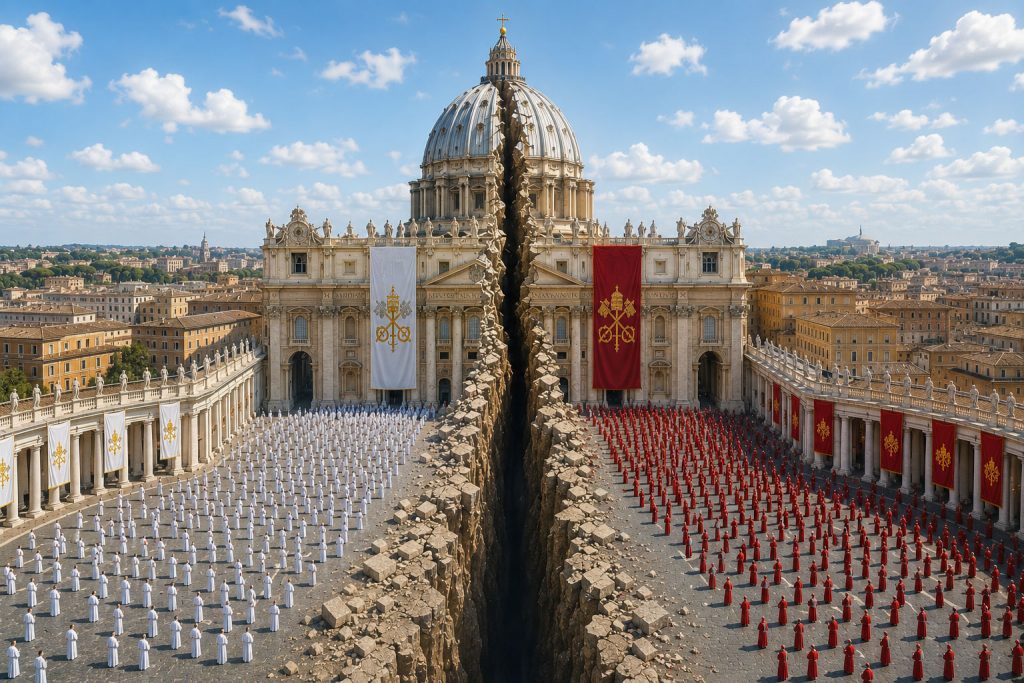
The planned July episcopal consecrations by the Society of St. Pius X (SSPX) once again expose deep divisions among faithful Catholics. For decades, Catholics committed to preserving the faith and traditions of the Church have disagreed not only about the crisis within the Church, but about how Catholics should respond to it.
For The Wanderer, this issue has long marked a major divide with The Remnant, the newspaper founded by a family member who formerly worked with his brother at The Wanderer. Much of that division traces back to differing responses to Archbishop Marcel Lefebvre and his resistance to post–Vatican II reforms.
The disagreement became so significant that it contributed to a split between two brothers at The Wanderer: This writer’s grandfather, Alphonse Matt, Sr., who remained with The Wanderer, and Walter Matt, his brother, who aligned more closely with Archbishop Lefebvre and later founded The Remnant some 60 years ago. At the time, The Remnant was so closely identified with support for the SSPX that its readers were commonly labeled Lefebites. Nearly six decades later, the same divisions remain, and recent events have brought them once again into the open and draw a clear distinction between the two newspapers.
Throughout those decades, The Wanderer has consistently defended Catholic Tradition, fought to preserve the sacred liturgy, and resisted the spread of modernism that threatens Catholic doctrine and Tradition. Yet its position has always been that these battles must be fought within the life of the Church — through the Catholic lens of Scripture, Tradition, and the Magisterium. Without fidelity to those foundations, there can be no authentic Catholic unity.
Today, those same voices claiming to defend Tradition openly support and encourage the SSPX to proceed with episcopal consecrations against the will of the pope. Such advice ignores the gravity of schism. Schism is not merely a political disagreement or an administrative dispute; it is a rupture in the unity of Christ’s Church.
The Church has always treated schism as a grave matter. History demonstrates its consequences. The East-West Schism permanently divided Eastern Orthodoxy and Roman Catholicism, while the Western Schism weakened the Church and caused widespread confusion throughout Europe.
Canon law likewise treats formal participation in schism seriously. Such participation generally involves knowingly rejecting the authority of the pope or supporting structures that separate themselves from communion with Rome. The Church distinguishes between criticism or confusion on one hand and deliberate rejection of ecclesial unity on the other.

Many supporters of the SSPX would have Catholics believe that the dispute between the society and Rome is solely about the Traditional Latin Mass. In doing so, they often minimize or dismiss the serious doctrinal and ecclesiological issues that are also at stake. For many, the predominant argument in defense of the SSPX is the claim that, were it not for the society, the Traditional Latin Mass would not exist today and would cease to exist without it. That claim is open to debate.
While the SSPX has undoubtedly played a significant role in preserving the Traditional Latin Mass, it cannot claim exclusive credit for its survival. It is inaccurate to suggest that the society alone safeguarded the Church’s liturgical tradition. Other communities, including the Priestly Fraternity of St. Peter (FSSP) and the Institute of Christ the King Sovereign Priest (ICKSP), have likewise preserved and promoted the Traditional liturgy while remaining in regular canonical status within the Church.
These communities provide Catholics with a means to participate in, support, and advance the Traditional Latin rite while remaining fully integrated into the life and structure of the Catholic Church.
Catholics may sympathize with some of the SSPX’s concerns, many of which are doctrinal as much as liturgical. Many faithful Catholics look at the influence of progressive and modernist elements within the Church — from heretical statements by some German bishops to figures such as “Fr.” James J. Martin, S.J. — and wonder why those perceived as challenging Catholic teaching often appear to face few consequences, while Catholics attached to Tradition are treated harshly.
Yet frustration and perceived injustice do not justify disobedience. The reasoning resembles a child’s asking, “Why does my sibling get away with it while I am punished?” Two wrongs do not make a right. Even if there are failures or inconsistencies within the Church, they do not grant anyone the authority to disregard the pope or act independently of the Church’s governing authority.
Another argument frequently raised by the SSPX and its supporters is that the Church is in a state of crisis or emergency. Even if one accepts that premise, the same argument was made in 1988 during the previous unauthorized consecrations.
In truth, the Church is always in crisis whenever sin is allowed to flourish. If the existence of a “crisis” alone justifies disobedience, then any Catholic group could declare an emergency whenever it believes Rome has failed and use that claim to override the Magisterium. No priest, bishop, or ecclesial movement possesses the authority to elevate itself above the visible hierarchical structure established by Christ for the governance of His Church, particularly the Roman pontiff.
Supporters of the SSPX also point out that the bishops consecrated in 1988 were originally excommunicated, but those excommunications were later lifted. While true, the lifting of those penalties was widely viewed as an act of generosity and reconciliation by Pope Benedict XVI, who repeatedly extended olive branches to the SSPX in hopes of restoring it to full communion with Rome. Acts of reconciliation by Rome should not be interpreted as approval of disobedience or as justification for repeating actions that risk further division within the Church.
Despite those efforts, the society has thus far declined to accept the Vatican’s conditions for reconciliation but insists that Rome accept its actions.
The fallback argument most often used by the SSPX is that it is ultimately “saving souls.” Yet schism places one outside full communion with the Catholic Church. The society’s actions ultimately undermine the very unity it claims to defend. What happened to “no salvation outside the Catholic church”? Preserving Tradition cannot come at the expense of loyalty to the pope and communion with the universal Church.
Much can be learned from the humility and the witness of countless faithful priests and Catholics throughout history who have endured suffering, confusion, and even injustice from ecclesiastical authority without separating themselves from the Church. The answer to crisis in the Church has never been rebellion through separation but submission to Christ and His Church.
All serious Catholics are obligated to defend and preserve the traditions and doctrine of the faith. But we must do so within the Church, not apart from it. The proper response now is prayer — prayer that the SSPX reconsider any action that could deepen division within the Church — and trust in God’s Providence rather than actions that risk causing even greater harm to a Church already suffering from crisis and confusion.
The SSPX should be encouraged to reconcile with Rome and work together with ecclesiastical authorities to preserve the traditions and doctrine that all Catholics should embrace. What is truly to be gained if the SSPX follows through with its consecrations — do its leaders and supporters really think they would become the one true apostolic Catholic Church? “Unite the clans” might be a clever slogan, but Catholics do not need to unite as clans. We need to unite as Catholics under the one true apostolic Church.