

LatestNews

Latest

This Week In The Wanderer . . . Issue of September 17, 2026

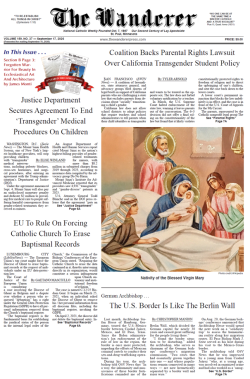
Subscribe To The Wanderer - Print or E-edition For Complete Stories The September 17, 2026 issue of The Wanderer focuses heavily on the defense of Catholic doctrine, parental authority, the sanctity of human
By JAMES MONTI , Latest

RESTORING THE SACRED . . . A Forgotten 17th-Century Treasure On The Mass

The issuance of a series of universally promulgated liturgical books for the Roman Rite following the Council of Trent over the years from 1568 to 1614 was intended to bring about a deepened
By Fr. KEVIN CUSICK , Latest

A Leaven In The World . . . The Myth Of Islamophobia

The truth about Islam: “The Muslim religion is the fastest-growing religion per capita in the United States, especially among minority races. “Last month I attended a training. During the training session, three speakers
By Dr. CHRISTOPHER MANION , Latest

The Mess Goes Far Beyond Massachusetts

Massachusetts Gov. Maura Healey’s office announced on Aug. 10 that she had “signed legislation strengthening abortion protections in Massachusetts, ensuring that patients experiencing serious pregnancy complications can receive medically appropriate care from their
By JOSEPH MATT , Latest

The Chair Of Peter Speaks . . .

Today's consecration of bishops without the papal mandate is most unfortunate. There are no victors—only another painful reminder of the divisions that continue to wound the Church. If there is any silver lining
Latest

Excommunication Decreed For Lefebvrian Episcopal Ordinations

A document signed by Cardinal Víctor Manuel Fernández, Prefect of the Dicastery for the Doctrine of the Faith, defines the rite celebrated on 1 July as an “act of a schismatic nature,” with
By JAMES MONTI , Latest

RESTORING THE SACRED . . . The Importance Of Good Catholic Books

Most if not all Wanderer readers can name at least one Catholic book that majorly impacted their lives. Many converts to the Catholic faith speak of how a seemingly chance encounter with a
By JAMES DRUMMEY , Latest

Catholic Replies

Q. My husband has often asked me what the fasting rule is for Communion. To play it safe, we always aim to fast one hour from the time of the scheduled Mass. We
By JAMES MONTI , Latest

RESTORING THE SACRED . . . The Mass As An Event Transcending All Else

Mankind’s highest undertakings have typically begun with a great deal of preparation. Columbus’ epic voyage of discovery in 1492 was no spur of the moment journey. The technology to land man on the
By DONALD DEMARCO , Latest

Conversion Through Pain

Her writings extended from drama and screen scenarios to fiction, journalism, and war reportage. As an author, she was best known for her 1936 play, Women, which, three years later, became a motion

This Week In The Wanderer . . . Issue of September 17, 2026

This Week In The Wanderer . . . Issue of September 17, 2026

The September 17, 2026 issue of The Wanderer focuses heavily on the defense of Catholic doctrine, parental authority, the sanctity of human life, religious liberty, and the relationship between Christianity and contemporary political and cultural issues. The issue also contains substantial material on Pope Leo XIV, the family, the Eucharist, sacred art, synodality, and the Church’s mission in the modern world.

The Wanderer Weekly Catholic Newspaper

Several prominent news stories address conflicts between Catholic principles and secular institutions. One of the lead stories concerns a legal challenge to California’s law restricting schools from requiring parents to be informed when a child identifies as transgender and seeks to be treated as the opposite sex. A coalition of 17 state attorneys general, five senators, and more than 70 organizations has filed briefs supporting parents who argue that they, rather than school officials, possess the fundamental responsibility for directing their children’s upbringing. The article emphasizes parental rights, religious liberty, and the constitutional protection of parents’ authority over their children.

Another major story reports that New York’s Mount Sinai Health System has agreed with the Justice Department to stop providing transgender medical interventions to minors, including puberty blockers, cross-sex hormones, and surgeries. The agreement also includes a financial penalty and $2 million for medical care for people harmed by such treatments received as minors. The article places the agreement within the Trump administration’s broader investigation of hospitals providing these procedures.

The issue also examines a European legal battle over Catholic baptismal records. The European Union’s Court of Justice is considering whether the Diocese of Ghent must erase baptismal information under the General Data Protection Regulation. European Catholic bishops argue that baptismal registers are not membership lists but historical records of sacramental acts. They maintain that forcing the Church to erase them would interfere with Church autonomy and religious freedom. The article emphasizes that baptism creates a permanent sacramental reality and that civil authorities should not redefine Catholic theology or the Church’s internal records.

A strongly critical theological article attacks a recent Vatican document for what the author regards as an excessive reliance on evolutionary cosmology and panentheism, particularly through the influence of Jesuit theologian Pierre Teilhard de Chardin. The article argues that the document’s approach risks weakening the traditional distinction between Creator and creation and could undermine doctrines concerning creation, original sin, redemption, grace, and Christ’s saving mission. The author contrasts these ideas with the teaching of the First Vatican Council concerning God’s transcendence.

Immigration is another prominent theme. One article reports President Trump’s warning that Spain could become a “ruined country” if it does not control mass immigration, citing unrest and pressures associated with migration into Ceuta. Another Wanderer commentary sharply criticizes German Archbishop Stefan Hesse’s comparison of U.S. border barriers to the Berlin Wall. The commentary argues that Catholic concern for migrants must be balanced with the legitimate responsibility of governments to control borders and protect citizens.

Internationally, the issue reports allegations that Israeli Prime Minister Benjamin Netanyahu was warned before the October 7, 2023 Hamas attack that a major operation was being planned. Netanyahu strongly denies the allegation and says there is no record of the alleged conversation. Opposition politicians have called for an investigation. The story therefore remains presented as a disputed allegation rather than an established fact.

The issue also addresses China. A column by Terence P. Jeffrey reports that the U.S. State Department continues to describe China’s treatment of Uyghurs and other minorities in Xinjiang as genocide and crimes against humanity. Jeffrey argues that the United States should make the issue a central component of its relationship with Beijing and calls for stronger consequences if the alleged abuses continue.

The pro-life theme receives extensive attention. A major article discusses Massachusetts legislation eliminating gestational limits on abortion and connects it to broader concerns about the treatment of newborn children with disabilities. The article highlights the case of Baby Gabriel, who was born with hypoplastic left heart syndrome after his surrogate mother refused demands to abort him. Texas intervened to ensure that the baby received life-saving treatment. The article argues that Christianity historically transformed societies by insisting that weak, disabled, and vulnerable people possess equal human dignity. It concludes that defending life requires not merely condemning abortion but building a practical “culture of life” through pregnancy support, adoption, medical assistance, and charitable action.

Another article examines the mistrial in the case of Lindsay Clancy, who is accused of killing her three young children. The discussion centers on the distinction between mental illness and moral responsibility. The article argues that compassion for a mentally ill mother should not cause society to lose sight of the victims—the children themselves.

The issue’s theological and catechetical material is extensive. A central theme is the Christian family as the “domestic church.” The family is presented as the first school of faith, virtue, prayer, forgiveness, responsibility, and service. Parents have a primary role in transmitting the faith and forming children morally.

Another article defends the importance of fraternal correction. Drawing on Scripture, it argues that Catholics have an obligation to correct serious sin, but that correction must be charitable, humble, private when possible, and aimed at bringing the sinner back to God rather than winning an argument. The article also discusses excommunication as a medicinal measure intended both to protect the community and encourage repentance.

The issue strongly emphasizes the Real Presence of Christ in the Eucharist. The Mass is described not merely as a religious gathering but as sacramental participation in Christ’s sacrifice on Calvary. Catholics are encouraged to recover reverence, prepare properly for Communion, spend time in Eucharistic adoration, and recognize Christ’s presence in the tabernacle.

The September 17 issue also contains a substantial defense of traditional sacred art and architecture. James Monti recalls earlier Catholic criticism of modern church architecture and art, especially work that he believes diminishes reverence. He highlights Cardinal Celso Costantini’s argument that churches should be beautiful places that lift the mind and soul toward God. The article concludes hopefully by noting that some younger priests are restoring traditional beauty to churches.

Finally, the issue discusses Pope Leo XIV’s call for unity and contemplation, his teaching on human dignity, and Catholic developments in China. The Pope emphasizes that authentic human dignity comes from being created by God and that freedom must remain connected to truth and responsibility. Meanwhile, the Vatican continues appointing bishops in China under its provisional agreement with Beijing.

Overall, the issue presents a consistent message: Catholic faith cannot be separated from truth, family, moral responsibility, human dignity, and the defense of vulnerable human life. The Wanderer portrays many contemporary political and cultural controversies as ultimately reflecting a deeper struggle over whether society will recognize objective moral truth and the authority of God, the family, and the Church.

This Week In The Wanderer . . . Issue of September 17, 2026

The September 17, 2026 issue of The Wanderer focuses heavily on the defense of Catholic doctrine, parental authority, the sanctity of human life, religious liberty, and the relationship between Christianity and contemporary political and cultural issues. The issue also contains substantial material on Pope Leo XIV, the family, the Eucharist, sacred art, synodality, and the Church’s mission in the modern world.

The Wanderer Weekly Catholic Newspaper

Several prominent news stories address conflicts between Catholic principles and secular institutions. One of the lead stories concerns a legal challenge to California’s law restricting schools from requiring parents to be informed when a child identifies as transgender and seeks to be treated as the opposite sex. A coalition of 17 state attorneys general, five senators, and more than 70 organizations has filed briefs supporting parents who argue that they, rather than school officials, possess the fundamental responsibility for directing their children’s upbringing. The article emphasizes parental rights, religious liberty, and the constitutional protection of parents’ authority over their children.

Another major story reports that New York’s Mount Sinai Health System has agreed with the Justice Department to stop providing transgender medical interventions to minors, including puberty blockers, cross-sex hormones, and surgeries. The agreement also includes a financial penalty and $2 million for medical care for people harmed by such treatments received as minors. The article places the agreement within the Trump administration’s broader investigation of hospitals providing these procedures.

The issue also examines a European legal battle over Catholic baptismal records. The European Union’s Court of Justice is considering whether the Diocese of Ghent must erase baptismal information under the General Data Protection Regulation. European Catholic bishops argue that baptismal registers are not membership lists but historical records of sacramental acts. They maintain that forcing the Church to erase them would interfere with Church autonomy and religious freedom. The article emphasizes that baptism creates a permanent sacramental reality and that civil authorities should not redefine Catholic theology or the Church’s internal records.

A strongly critical theological article attacks a recent Vatican document for what the author regards as an excessive reliance on evolutionary cosmology and panentheism, particularly through the influence of Jesuit theologian Pierre Teilhard de Chardin. The article argues that the document’s approach risks weakening the traditional distinction between Creator and creation and could undermine doctrines concerning creation, original sin, redemption, grace, and Christ’s saving mission. The author contrasts these ideas with the teaching of the First Vatican Council concerning God’s transcendence.

Immigration is another prominent theme. One article reports President Trump’s warning that Spain could become a “ruined country” if it does not control mass immigration, citing unrest and pressures associated with migration into Ceuta. Another Wanderer commentary sharply criticizes German Archbishop Stefan Hesse’s comparison of U.S. border barriers to the Berlin Wall. The commentary argues that Catholic concern for migrants must be balanced with the legitimate responsibility of governments to control borders and protect citizens.

Internationally, the issue reports allegations that Israeli Prime Minister Benjamin Netanyahu was warned before the October 7, 2023 Hamas attack that a major operation was being planned. Netanyahu strongly denies the allegation and says there is no record of the alleged conversation. Opposition politicians have called for an investigation. The story therefore remains presented as a disputed allegation rather than an established fact.

The issue also addresses China. A column by Terence P. Jeffrey reports that the U.S. State Department continues to describe China’s treatment of Uyghurs and other minorities in Xinjiang as genocide and crimes against humanity. Jeffrey argues that the United States should make the issue a central component of its relationship with Beijing and calls for stronger consequences if the alleged abuses continue.

The pro-life theme receives extensive attention. A major article discusses Massachusetts legislation eliminating gestational limits on abortion and connects it to broader concerns about the treatment of newborn children with disabilities. The article highlights the case of Baby Gabriel, who was born with hypoplastic left heart syndrome after his surrogate mother refused demands to abort him. Texas intervened to ensure that the baby received life-saving treatment. The article argues that Christianity historically transformed societies by insisting that weak, disabled, and vulnerable people possess equal human dignity. It concludes that defending life requires not merely condemning abortion but building a practical “culture of life” through pregnancy support, adoption, medical assistance, and charitable action.

Another article examines the mistrial in the case of Lindsay Clancy, who is accused of killing her three young children. The discussion centers on the distinction between mental illness and moral responsibility. The article argues that compassion for a mentally ill mother should not cause society to lose sight of the victims—the children themselves.

The issue’s theological and catechetical material is extensive. A central theme is the Christian family as the “domestic church.” The family is presented as the first school of faith, virtue, prayer, forgiveness, responsibility, and service. Parents have a primary role in transmitting the faith and forming children morally.

Another article defends the importance of fraternal correction. Drawing on Scripture, it argues that Catholics have an obligation to correct serious sin, but that correction must be charitable, humble, private when possible, and aimed at bringing the sinner back to God rather than winning an argument. The article also discusses excommunication as a medicinal measure intended both to protect the community and encourage repentance.

The issue strongly emphasizes the Real Presence of Christ in the Eucharist. The Mass is described not merely as a religious gathering but as sacramental participation in Christ’s sacrifice on Calvary. Catholics are encouraged to recover reverence, prepare properly for Communion, spend time in Eucharistic adoration, and recognize Christ’s presence in the tabernacle.

The September 17 issue also contains a substantial defense of traditional sacred art and architecture. James Monti recalls earlier Catholic criticism of modern church architecture and art, especially work that he believes diminishes reverence. He highlights Cardinal Celso Costantini’s argument that churches should be beautiful places that lift the mind and soul toward God. The article concludes hopefully by noting that some younger priests are restoring traditional beauty to churches.

Finally, the issue discusses Pope Leo XIV’s call for unity and contemplation, his teaching on human dignity, and Catholic developments in China. The Pope emphasizes that authentic human dignity comes from being created by God and that freedom must remain connected to truth and responsibility. Meanwhile, the Vatican continues appointing bishops in China under its provisional agreement with Beijing.

Overall, the issue presents a consistent message: Catholic faith cannot be separated from truth, family, moral responsibility, human dignity, and the defense of vulnerable human life. The Wanderer portrays many contemporary political and cultural controversies as ultimately reflecting a deeper struggle over whether society will recognize objective moral truth and the authority of God, the family, and the Church.

Subscribe To The Wanderer - Print or E-edition For Complete Stories The September 17, 2026 issue of The Wanderer focuses heavily on the defense of Catholic doctrine, parental authority, the sanctity of human life, religious liberty, and the relationship between Christianity and contemporary political and cultural issues. The issue also contains substantial material on Pope Leo XIV, the family, the Eucharist, sacred art, synodality, and the Church's mission in the modern world. The Wanderer Weekly Catholic Newspaper Several prominent news stories address conflicts between Catholic principles and secular institutions. One of the lead stories concerns a legal challenge to California's law restricting schools from requiring parents to be informed when a child identifies as transgender and seeks to be treated as the opposite sex. A coalition of 17 state attorneys general, five senators, and more than 70 organizations has filed briefs supporting parents who argue that they, rather than school officials, possess the fundamental responsibility for directing their children's upbringing.

This article is available to E- Edition subscribers only.

Support trusted Catholic journalism by subscribing to The Wanderer.

Subscribe Now

E-Edition

$7/month


  • access All Online Articles.

  • Read the Wanderer print edition and news articles online on your smartphone, tablet, and PC.

  • Your source for weekly Catholic news and commentary. Catholic, conservative, orthodox, and loyal to the Magisterium.


$60 yearly subscription


[leaky_paywall_subscription]