

LatestNews

By JAMES MONTI , Latest

RESTORING THE SACRED

Holy Week In Corsica The Mediterranean island of Corsica is a culturally unique place with a largely French modern history but with a considerable Italian past. Its Holy Week customs are deeply rooted
By Dr. CHRISTOPHER MANION , Latest

‘Hey, So What? That’s Old News!’

That was the slogan of Bill Clinton’s ace defender James Carville when one after another of the rapist’s crimes came across the screen. It worked, and the next generation of Democrats has now
By DONALD DEMARCO , Latest

Ethics And Language

A language develops in mysterious ways. How it emerges from grunts and groans to the highly complex and intricate web of meaning eludes scientific explanation. Nonetheless, what is known is that it develops
By JAMES DRUMMEY , Latest

Catholic Replies

Question. If I dream that I killed someone, would God consider that a sin? — J.B., Pa. Answer. No, we are not morally responsible for sinful actions that occur in dreams. The only
By Fr. KEVIN CUSICK , Latest

A Leaven In The World . . . Exorcists Spreading Dangerous Private Revelation

Of the many aberrations spawned in the instability and confusion of the post–Vatican II era, the promotion of private revelation has to be one of the most dangerous. One can find many overexposed
By Dr. CHRISTOPHER MANION , Latest

The Plight Of The Illegal Immigrant

The immigration debate that rages in the United States and Western Europe today focuses on the impact of immigrants, both legal and illegal, in their countries of destination. In order better to understand
By Fr. KEVIN CUSICK , Latest

A Leaven In The World . . . Don’t Get Distracted From The Real War

The Catholic commentariat, in the wake of the opening salvos of the war in Iran, has, if you’ll forgive the pun, exploded. Many voices are untethered from Catholic just-war and social teaching. Some
By Dr. CHRISTOPHER MANION , Latest

Cheer, Cheer For Old Notre Dame!

It’s been a rough ride, but the Fighting Irish finally have something to celebrate this St. Paddy’s Day. In recent weeks, The Wanderer has reported on the latest controversy that has embroiled Our
By JAMES MONTI , Latest

RESTORING THE SACRED . . . The Reality Of The Sacred Passion

The Lenten season comes each year as a veritable retreat for the Church throughout the world, a particularly “acceptable time” (2 Cor. 6:2) for all of us to begin anew the pursuit of
By Dr. CHRISTOPHER MANION , Latest

The Swill Of DEI

If there was ever a close-up, in-person example of the impact of a bad idea, it is the District of Columbia’s embrace of former President Joe Biden’s DEI lunacy five years ago. The

RESTORING THE SACRED

RESTORING THE SACRED

Holy Week In Corsica

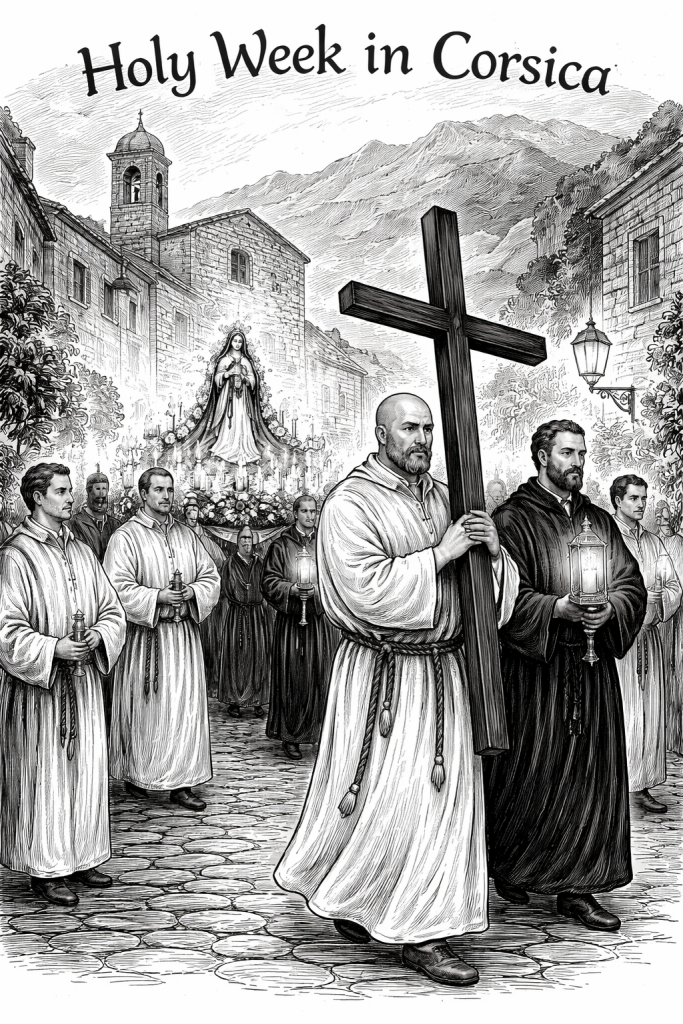
The Mediterranean island of Corsica is a culturally unique place with a largely French modern history but with a considerable Italian past. Its Holy Week customs are deeply rooted in the Italian phase of its history, yet they have taken on a distinctly Corsican character all its own.

The fashioning of palm branches into a variety of artistic creations is a prevalent custom for Palm Sunday across Corsica. The finest examples, the pullezulle, are made by braiding the palms to construct depictions of religious symbols ranging from the cross and the fish to hearts and roses. The most elaborate pullezulle take the form of miniature churches.

In the past, it was customary to make a special pullezulle for use on Good Friday as an adornment for the top of processional crosses, with the work of making this decoration beginning on Monday of Holy Week.

On Wednesday of Holy Week, the erection in the churches of extraordinary Passion-themed shrines begins, enclosures traditionally referred to as “sepolcri,” “sepulchers,” mostly intended to represent the tomb of Christ.

Many of these shrines were built, and still are, specifically for the purpose of reposing the Blessed Sacrament following Mass on Holy Thursday, in keeping with a centuries-old custom (from at least as far back as the 1100s) that has symbolically associated the Holy Thursday reposition of the Eucharist with the burial of Christ. Others are constructed simply to provide a beautiful setting for an image of Christ that is singled out to be the primary object of devotion and prayerful meditation within the “sepolcro.”

The construction of Holy Week sepolcri is by no means unique to Corsica, but what makes these structures in the Corsican churches quite distinctive is the almost universal employment of two-dimensional figures and scenography painted on cloth hangings, canvases, wood, and even cardboard.

The oldest known Corsican reference to a sepolcro for the Holy Thursday reposition of the Blessed Sacrament dates from 1557. The earliest manner for erecting a Corsican sepolcro was in the form of a majestic pavilion tent not unlike the tents raised to shelter a king on the battlefield in ages past. Some Corsican repositories are still erected in this pavilion form.

By the late 1600s, this basic configuration was enhanced by the introduction of painted fabric walls for the sepolcro, with detailed depictions of a whole range of Passion scenes fastened to wooden frames that could be assembled each year to create a veritable “burial chamber.”

One of the recurrent images on these painted sepolcro walls of fabric is that of two angels holding up by its lateral edge the shroud of Christ so as to reveal to the viewer the body of Christ resting within the shroud. In other painted scenes, the Crucifixion or the taking down of Christ from the Cross is dramatically portrayed.

Rather than being in the style of the “Great Masters,” these artworks are done in a more rustic manner solely to move the worshiper to compassion for our Lord and our Lady and to contrition for one’s own sins.

As a later variant of the practice of painted fabric walls, there arose a Corsican custom of making a two-dimensional façade in the form of a screen of painted canvas stretched on a wooden frame to enclose the side chapel that served as the Holy Thursday repository. These screens typically had a door-sized opening at the lower middle where those visiting the Blessed Sacrament could enter and exit.

Yet another form of adornment for the sepolcri in Corsica consists of ensembles of two-dimensional silhouette depictions of the various figures of the Passion, most especially of Christ resting in death, Our Lady of Sorrows, St. Mary Magdalene, the angels at the tomb, and the soldiers posted to guard the tomb.

The religious confraternities in Corsica carry out processions on Holy Thursday, led by a decorated processional cross, that go from one church to another to visit the repositories.

Good Friday is by far the most emotionally intense day of the entire liturgical year in Corsica. Many Corsican cities and villages carry out street processions of a stational nature, most especially after nightfall, with oil lamps and candles on windowsills casting a haunting glimmer to light the way below.

Corsica’s most famous and unique Holy Week tradition unfolds on Good Friday, the “Catenacciu,” traceable back to the 13th century, in which one particular penitent with a concealed identity fully enacts the 14 Stations of the Cross in the role of Christ Crucified. This observance is said to have arisen from a miracle in which a prisoner was unfettered from his chains after touching a relic of the True Cross.

The most revered of all Catenacciu processions is the one carried out each Good Friday in the town of Sartene. The identity of the penitent chosen to take the part of Christ in the procession is known only by the parish priest and by the Franciscans of a friary outside of Sartene where the penitent goes to confession before participating in the ceremony.

As a penance for his own sins, he must carry a heavy wooden cross barefoot for a distance of over a mile with a heavy chain on his right foot. It is considered to be such a deeply cherished privilege to be chosen for the role of Christ in the Catenacciu that it usually takes ten to twelve years to be selected from all those who have placed their names on the waiting list.

At 9:30 p.m., the rite begins at the high altar in Sartene’s Church of St. Mary, where a statue of Christ recumbent in death rests upon a bier on the top step before the altar. Directly in front of it a large oak cross over nine feet high and weighing over eighty pounds has been placed, resting diagonally from the middle of the altar’s mensa down to the floor.

Eight barefoot penitents clothed in black robes and hoods emerge from a door to the left and prostrate themselves upon the altar steps, with four to the left of the altar and four to the right. Another penitent, clothed and hooded in white with a purple sash, emerges next and kneels on the left side of the oak cross — he will assume the role of Simon of Cyrene in the procession to follow.

Finally, the penitent chosen to enact the role of Christ emerges and kneels on the right side of the cross, clothed in a bright red robe, gloves, and hood symbolizing the Blood of our Lord. A member of the Holy Week confraternity in charge of the procession, the Company of the Most Holy Sacrament, then fastens to the right ankle of the red-clothed penitent a metal chain weighing over 37 pounds.

The red penitent sets out into the streets of Sartene, carrying the 80-pound oak cross and walking barefoot on the cobblestone pavement, with the chain dragging behind. He is preceded and accompanied by a large retinue of the Company of the Most Holy Sacrament, the clergy, and the acolytes as the white-robed penitent playing the part of Simon walks with him. Behind them, four of the black-robed penitents carry on a bier a statue of Christ laid out in death as the four other black-robed penitents bear on poles a black canopy over the recumbent Christ.

Bystanders keep a total silence that preserves an atmosphere of prayerful meditation for all in attendance. The only sounds to be heard are the rattles of the red penitent’s chain dragging behind him and the sacred chants sung during the procession, most especially the repeated supplication, “Perdono mio Dio” (“Forgive me, God”).

In keeping with his role of enacting the 14 Stations of the Cross, the red-clothed penitent falls three times along the route. The procession takes two to three hours to complete, concluding at the church within which it began, with the red-clothed penitent released from his chain after arriving at the high altar.

A number of other Corsican towns and villages carry out a Catenacciu procession similar to that of Sartene. But there are also many other Good Friday processions in Corsica that take place in a different manner, often earlier in the day.

A particularly distinctive Corsican custom among the confraternities in this regard is that of processing along a sinuous, spiraling path, a marching maneuver usually carried out outside a church that the confraternity is visiting in the course of the procession. Still other processions have as their primary focus that of carrying and accompanying an image of Christ resting in death on a bier to a church where it will be laid to rest.

A particularly dramatic form of the above-mentioned “funeral procession” for Christ in death begins with a reenactment of the taking down of Christ from the cross, a custom found elsewhere in Catholic Europe that can be traced back to 14th-century Assisi. A large crucifix with a flexible and detachable corpus is employed. At the church where the procession is to begin, the nails that hold the corpus to the cross are ceremonially extracted as the corpus is reverently removed and lowered down onto a bier.

The story of Holy Week in modern-day Corsica is also a story of rebirth. For although Corsica’s Holy Week heritage suffered a serious decline during the second half of the 20th century, a growing effort has emerged over the last 30 years not only to preserve these customs where they have survived but to reintroduce them in places where they had long ago disappeared.

Around 1997, Elizabeth Pardon, an art and music scholar, visited the Corsican village of Castellu di Rustinu.  While there, an elderly lady of the local parish gave Pardon a tour of the village church.

On passing through a corridor behind the altar during the tour, Pardon spotted a set of huge painted canvases carelessly piled against the wall. She asked her elderly guide what they were and learned that they had been used for the Holy Thursday sepolcro when she was a little girl.

Pardon subsequently set in motion a successful project to “recover” the long-discarded custom of erecting these early 19th-century painted canvases for the rites of Holy Thursday.

In 2015, a confraternity in the Corsican village of Munticellu reintroduced its centuries-old Good Friday custom of ceremonially un-nailing from the cross and laying to rest an image of Christ Crucified after having repaired the 17th-century corpus of our Lord that had lain unused for over 80 years.

Indeed, there is no better time to recover our Catholic heritage than Holy Week. May all of us be blessed to find in a church nearby liturgical and devotional rites for these most sacred days of the year that are truly steeped in the robust piety of our forefathers in the faith.
RESTORING THE SACRED

Holy Week In Corsica

The Mediterranean island of Corsica is a culturally unique place with a largely French modern history but with a considerable Italian past. Its Holy Week customs are deeply rooted in the Italian phase of its history, yet they have taken on a distinctly Corsican character all its own.

The fashioning of palm branches into a variety of artistic creations is a prevalent custom for Palm Sunday across Corsica. The finest examples, the pullezulle, are made by braiding the palms to construct depictions of religious symbols ranging from the cross and the fish to hearts and roses. The most elaborate pullezulle take the form of miniature churches.

In the past, it was customary to make a special pullezulle for use on Good Friday as an adornment for the top of processional crosses, with the work of making this decoration beginning on Monday of Holy Week.

On Wednesday of Holy Week, the erection in the churches of extraordinary Passion-themed shrines begins, enclosures traditionally referred to as “sepolcri,” “sepulchers,” mostly intended to represent the tomb of Christ.

Many of these shrines were built, and still are, specifically for the purpose of reposing the Blessed Sacrament following Mass on Holy Thursday, in keeping with a centuries-old custom (from at least as far back as the 1100s) that has symbolically associated the Holy Thursday reposition of the Eucharist with the burial of Christ. Others are constructed simply to provide a beautiful setting for an image of Christ that is singled out to be the primary object of devotion and prayerful meditation within the “sepolcro.”

The construction of Holy Week sepolcri is by no means unique to Corsica, but what makes these structures in the Corsican churches quite distinctive is the almost universal employment of two-dimensional figures and scenography painted on cloth hangings, canvases, wood, and even cardboard.

The oldest known Corsican reference to a sepolcro for the Holy Thursday reposition of the Blessed Sacrament dates from 1557. The earliest manner for erecting a Corsican sepolcro was in the form of a majestic pavilion tent not unlike the tents raised to shelter a king on the battlefield in ages past. Some Corsican repositories are still erected in this pavilion form.

By the late 1600s, this basic configuration was enhanced by the introduction of painted fabric walls for the sepolcro, with detailed depictions of a whole range of Passion scenes fastened to wooden frames that could be assembled each year to create a veritable “burial chamber.”

One of the recurrent images on these painted sepolcro walls of fabric is that of two angels holding up by its lateral edge the shroud of Christ so as to reveal to the viewer the body of Christ resting within the shroud. In other painted scenes, the Crucifixion or the taking down of Christ from the Cross is dramatically portrayed.

Rather than being in the style of the “Great Masters,” these artworks are done in a more rustic manner solely to move the worshiper to compassion for our Lord and our Lady and to contrition for one’s own sins.

As a later variant of the practice of painted fabric walls, there arose a Corsican custom of making a two-dimensional façade in the form of a screen of painted canvas stretched on a wooden frame to enclose the side chapel that served as the Holy Thursday repository. These screens typically had a door-sized opening at the lower middle where those visiting the Blessed Sacrament could enter and exit.

Yet another form of adornment for the sepolcri in Corsica consists of ensembles of two-dimensional silhouette depictions of the various figures of the Passion, most especially of Christ resting in death, Our Lady of Sorrows, St. Mary Magdalene, the angels at the tomb, and the soldiers posted to guard the tomb.

The religious confraternities in Corsica carry out processions on Holy Thursday, led by a decorated processional cross, that go from one church to another to visit the repositories.

Good Friday is by far the most emotionally intense day of the entire liturgical year in Corsica. Many Corsican cities and villages carry out street processions of a stational nature, most especially after nightfall, with oil lamps and candles on windowsills casting a haunting glimmer to light the way below.

Corsica’s most famous and unique Holy Week tradition unfolds on Good Friday, the “Catenacciu,” traceable back to the 13th century, in which one particular penitent with a concealed identity fully enacts the 14 Stations of the Cross in the role of Christ Crucified. This observance is said to have arisen from a miracle in which a prisoner was unfettered from his chains after touching a relic of the True Cross.

The most revered of all Catenacciu processions is the one carried out each Good Friday in the town of Sartene. The identity of the penitent chosen to take the part of Christ in the procession is known only by the parish priest and by the Franciscans of a friary outside of Sartene where the penitent goes to confession before participating in the ceremony.

As a penance for his own sins, he must carry a heavy wooden cross barefoot for a distance of over a mile with a heavy chain on his right foot. It is considered to be such a deeply cherished privilege to be chosen for the role of Christ in the Catenacciu that it usually takes ten to twelve years to be selected from all those who have placed their names on the waiting list.

At 9:30 p.m., the rite begins at the high altar in Sartene’s Church of St. Mary, where a statue of Christ recumbent in death rests upon a bier on the top step before the altar. Directly in front of it a large oak cross over nine feet high and weighing over eighty pounds has been placed, resting diagonally from the middle of the altar’s mensa down to the floor.

Eight barefoot penitents clothed in black robes and hoods emerge from a door to the left and prostrate themselves upon the altar steps, with four to the left of the altar and four to the right. Another penitent, clothed and hooded in white with a purple sash, emerges next and kneels on the left side of the oak cross — he will assume the role of Simon of Cyrene in the procession to follow.

Finally, the penitent chosen to enact the role of Christ emerges and kneels on the right side of the cross, clothed in a bright red robe, gloves, and hood symbolizing the Blood of our Lord. A member of the Holy Week confraternity in charge of the procession, the Company of the Most Holy Sacrament, then fastens to the right ankle of the red-clothed penitent a metal chain weighing over 37 pounds.

The red penitent sets out into the streets of Sartene, carrying the 80-pound oak cross and walking barefoot on the cobblestone pavement, with the chain dragging behind. He is preceded and accompanied by a large retinue of the Company of the Most Holy Sacrament, the clergy, and the acolytes as the white-robed penitent playing the part of Simon walks with him. Behind them, four of the black-robed penitents carry on a bier a statue of Christ laid out in death as the four other black-robed penitents bear on poles a black canopy over the recumbent Christ.

Bystanders keep a total silence that preserves an atmosphere of prayerful meditation for all in attendance. The only sounds to be heard are the rattles of the red penitent’s chain dragging behind him and the sacred chants sung during the procession, most especially the repeated supplication, “Perdono mio Dio” (“Forgive me, God”).

In keeping with his role of enacting the 14 Stations of the Cross, the red-clothed penitent falls three times along the route. The procession takes two to three hours to complete, concluding at the church within which it began, with the red-clothed penitent released from his chain after arriving at the high altar.

A number of other Corsican towns and villages carry out a Catenacciu procession similar to that of Sartene. But there are also many other Good Friday processions in Corsica that take place in a different manner, often earlier in the day.

A particularly distinctive Corsican custom among the confraternities in this regard is that of processing along a sinuous, spiraling path, a marching maneuver usually carried out outside a church that the confraternity is visiting in the course of the procession. Still other processions have as their primary focus that of carrying and accompanying an image of Christ resting in death on a bier to a church where it will be laid to rest.

A particularly dramatic form of the above-mentioned “funeral procession” for Christ in death begins with a reenactment of the taking down of Christ from the cross, a custom found elsewhere in Catholic Europe that can be traced back to 14th-century Assisi. A large crucifix with a flexible and detachable corpus is employed. At the church where the procession is to begin, the nails that hold the corpus to the cross are ceremonially extracted as the corpus is reverently removed and lowered down onto a bier.

The story of Holy Week in modern-day Corsica is also a story of rebirth. For although Corsica’s Holy Week heritage suffered a serious decline during the second half of the 20th century, a growing effort has emerged over the last 30 years not only to preserve these customs where they have survived but to reintroduce them in places where they had long ago disappeared.

Around 1997, Elizabeth Pardon, an art and music scholar, visited the Corsican village of Castellu di Rustinu.  While there, an elderly lady of the local parish gave Pardon a tour of the village church.

On passing through a corridor behind the altar during the tour, Pardon spotted a set of huge painted canvases carelessly piled against the wall. She asked her elderly guide what they were and learned that they had been used for the Holy Thursday sepolcro when she was a little girl.

Pardon subsequently set in motion a successful project to “recover” the long-discarded custom of erecting these early 19th-century painted canvases for the rites of Holy Thursday.

In 2015, a confraternity in the Corsican village of Munticellu reintroduced its centuries-old Good Friday custom of ceremonially un-nailing from the cross and laying to rest an image of Christ Crucified after having repaired the 17th-century corpus of our Lord that had lain unused for over 80 years.

Indeed, there is no better time to recover our Catholic heritage than Holy Week. May all of us be blessed to find in a church nearby liturgical and devotional rites for these most sacred days of the year that are truly steeped in the robust piety of our forefathers in the faith.

Holy Week In Corsica The Mediterranean island of Corsica is a culturally unique place with a largely French modern history but with a considerable Italian past. Its Holy Week customs are deeply rooted in the Italian phase of its history, yet they have taken on a distinctly Corsican character all its own. The fashioning of palm branches into a variety of artistic creations is a prevalent custom for Palm Sunday across Corsica. The finest examples, the pullezulle, are made by braiding the palms to construct depictions of religious symbols ranging from the cross and the fish to hearts and roses. The most elaborate pullezulle take the form of miniature churches.

This article is available to E- Edition subscribers only.

Support trusted Catholic journalism by subscribing to The Wanderer.

Subscribe Now

E-Edition

$7/month


  • access All Online Articles.

  • Read the Wanderer print edition and news articles online on your smartphone, tablet, and PC.

  • Your source for weekly Catholic news and commentary. Catholic, conservative, orthodox, and loyal to the Magisterium.


$60 yearly subscription


[leaky_paywall_subscription]

Author’s Archives

By JAMES MONTI

RESTORING THE SACRED . . . The Reality Of The Sacred Passion

The Lenten season comes each year as a veritable retreat for the Church throughout the world, a particularly “acceptable time” (2 Cor.…

Restoring The Sacred

Meditating Upon The Scourging Of Christ Through Scripture And Art By JAMES MONTI Everything about Lent directs our thoughts toward the Passion…