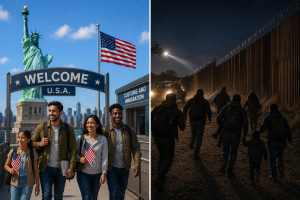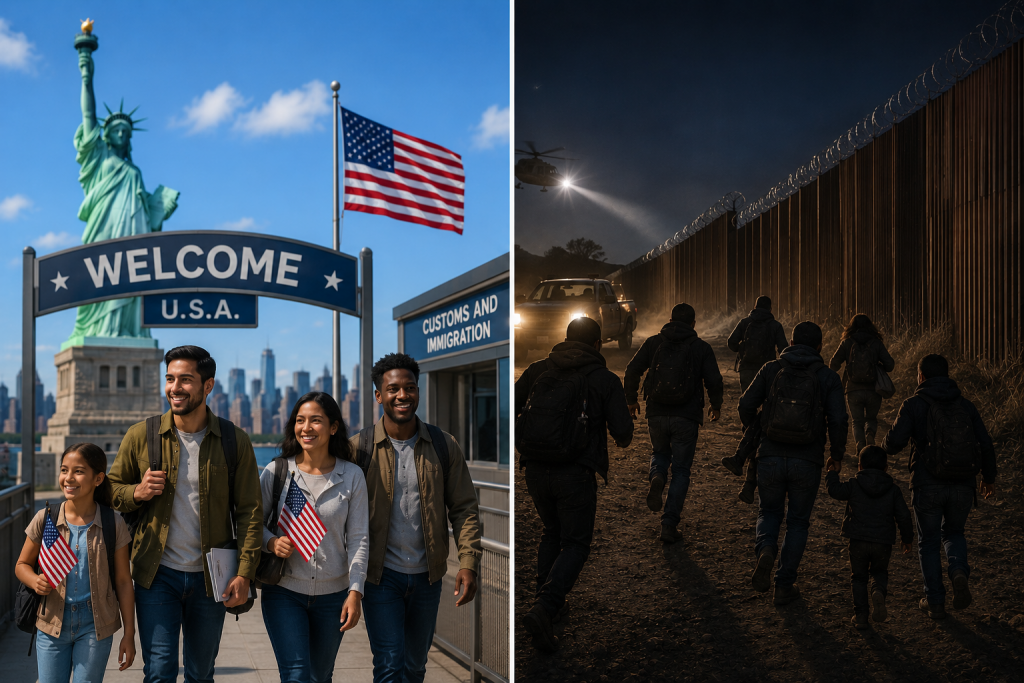
While Pope Leo has confronted President Trump on the war in Iran, he has not relented in his aggressive campaign against the president’s policies regarding immigration.
This month alone, he has appointed three new Hispanic bishops to U.S. dioceses. Of the some two dozen appointments he has made since his election, about 40% are foreign-born.
In 2011, Los Angeles Archbishop José Gómez predicted a “Next America” that would be Hispanic. Pope Leo has embraced that theme as the focus of both his policies and his episcopal appointments regarding the United States.
Specifically, His Holiness is signaling in every possible way his opposition the policies of President Donald J. Trump in anticipation of this November’s midterm elections.
No longer will we hear only of bishops leading marches on the facilities of the Immigration and Customs Enforcement. Yes, ordinaries of various dioceses will dutifully continue to publish their rewrites of the pastoral templates provided by the U.S. Conference of Catholic Bishops’ Peace and Justice and Migration offices, but these have proven to be insufficient in swaying American opinion to favor more Biden-style illegal immigration that our bishops celebrated (and, sadly, cashed in on).
A Thought . . . Professional Speaks
We will be looking at these trends more closely in coming months. To offer a perspective, we present the views of Dr. Louis Segesvary, a longtime U.S. Foreign Service officer who has served throughout Africa and Latin America in key positions, including that of Chief Consul of the U.S. Embassy in Switzerland.
Dr. Segesvary’s views are stunning in their calm and measured tone as he explains the two ways that prospective immigrants can approach the issue — legally and illegally — and the consequences both for the United States as well as for the immigrant.
It is helpful to contrast his approach, both in content and in spirit, with that of our beloved American shepherds.
So allow me to introduce Dr. Segesvary’s thoughts on the issue:
“As waves upon waves of migrants enter the United States illicitly through our southern border, lost in the panorama of scenes of waders in the Rio Grande, itinerants in the desert, and passengers hidden in heavy wheel trucks are other poignant scenes, in their own way no less compelling, playing themselves out at our embassies throughout Latin America and Africa.
“In one embassy after another, whether in Guatemala or Kenya, there are hundreds of hopeful applicants waiting for their chance to be interviewed by an embassy officer and considered for an immigration visa to America. They have pinned all their hopes for a better life on this one encounter with an unknown official who will grant their wishes or dismiss them.
“These can be tense encounters, both for the interviewing officer and for the applicant, since what is at stake is nothing less than lawful passage into America and all it offers. The officer is bound by the requirements of immigration law; the latter is bound by the demands of appearances. Caught just in one falsehood about their past or present, applicants can see their chances ruined for good. And yet, around the world, there is no end to the potential lines of would-be applicants.
“According to a well-known Gallup survey publicized in 2021, 27% of the 450 million people in Latin America and the Caribbean want to leave their homes permanently, with 35% of that number, or 42 million people, having the United States as their goal. And in sub-Saharan Africa, another Gallup survey shows that 33% of its 1.14 billion population wish to leave and go elsewhere, a percentage which translates to well over 300 million people.
“There too, the United States is a popular potential destination. Desiring to leave does not mean planning to leave, of course, yet the numbers in play remain daunting.
“While complying with American immigration law can be a challenging exercise for some applicants, with a criminal background or a tainted health history grounds for ineligibility, qualified applicants continue to be welcome with the potential number that can be granted immigration visas to the United States reflecting a true spirit of generosity.
“There are now tens of millions of migrants, in jurisprudence also known as illegal aliens, residing in the United States who eschewed proper channels to enter our country. Of course, they could have chosen to apply at an embassy for lawful entrance, but that can involve long waiting periods and is the road increasingly less traveled.
“The temptation of quick and easy passage into the United States, by slipping through its porous southern border, is for many irresistible. And who can argue with the moral justification of seeking a better life.
“And yet, around the world, including in nearby Latin American nations, there are many thousands of people also in search of a better life anxiously waiting for an interview who take the rules of entry to our country more seriously and abide by them. Regrettably, theirs remains for the most part a hidden landscape, far from our collective sight.
“And just as seemingly hidden is another dimension as to what is at stake for the waiting applicants as well as for the undocumented migrants that arrive here one way or another. If we can look past the material dimension of our existence and consider the realm of the inner person, we may be able to understand more fully what these stakes are. For playing by the rules can have its own reward that in the end may prove superior to only the attributes of a better material life.
“This reward is nothing less than the inner confidence and peace that comes with living a life of unflinching personal integrity. For with this serenity, even though one may still be materially poor, walking tall with one’s head held high comes as naturally as looking at others straight in the eye. Maybe waiting patiently in line is the better choice after all.”
Thus far Doctor Segesvary.
Wouldn’t it be wonderful if our beloved shepherds, having promised us “transparency” and “accountability” a quarter-century ago, could look us “straight in the eye” and tell us the truth about their immigration advocacy?
Or is that too dangerous a prospect?
Why not ask them?
Pray for our bishops.