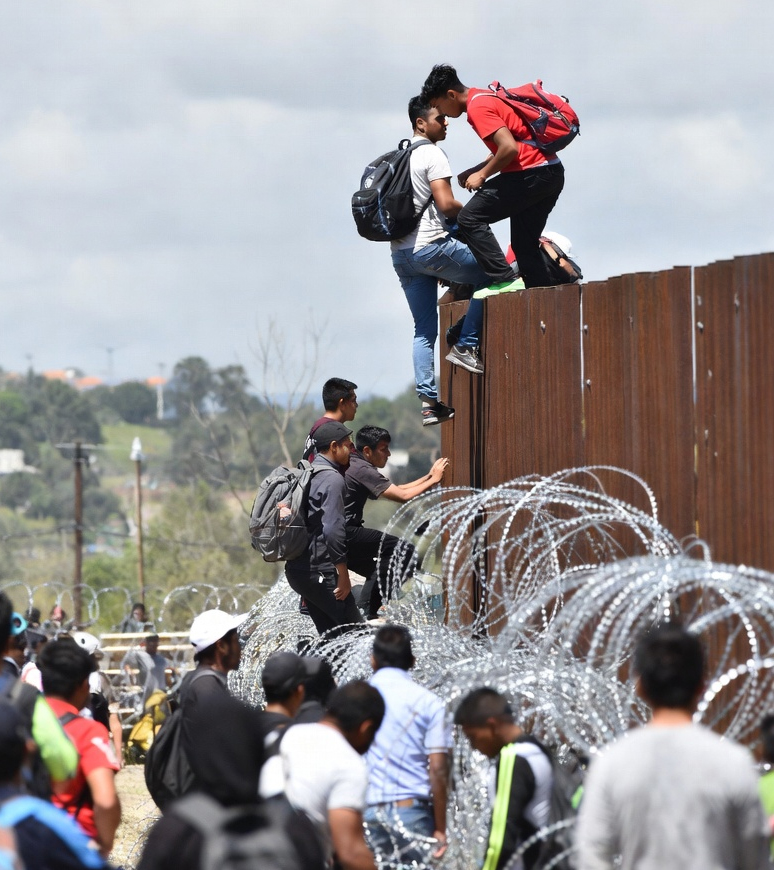
The immigration debate that rages in the United States and Western Europe today focuses on the impact of immigrants, both legal and illegal, in their countries of destination. In order better to understand that impact, it’s worth taking a look at where they’re coming from.
The majority of Third World countries’ populations suffer from poverty. Of course, for millennia the entire population of the world was desperately poor. Only since the early 1800s have those suffering from such abject impoverishment found it possible to rise out of their formerly permanent condition, and billions have done so.
How that came to pass is, however, as Mr. Anzures, my Spanish teacher in Mexico, put it 63 years ago, “flour of another sack.” But the realization that they could improve their condition was both new and powerful.
And the very possibility of economic development implanted in the consciousness of those populations plays the fundamental role in today’s immigration crisis.
Let’s take a look at some of the core issues that those populations face.
Of course, poverty is often foremost among them. But their corrupt rulers do not readily accept the blame; rather, they always lie, they rule harshly, and they always blame somebody else.
The Iron Discipline
Of Corruption
As Lord Peter Bauer, the famous international economist, put it 50 years ago at a conference in Airlie, Va., “Third World countries have cultures so radically different from each other that they have only one thing in common: their tyrants always tell them that ‘your poverty is America’s fault’.”
That blunt rule stokes a sense of resentment not against the tyrant, but against America. It is the common denominator that keeps dictators in power and redirects the anger and envy that pervades subject populations.
So for the moment we recognize not only poverty, but the widespread belief regarding its root cause.
Corruption Is
As Corruption Does
Every Third World regime features a thoroughgoing culture of corruption. It is so profound that many can hardly imagine a different way of life.
I am reminded of a recent YouTube video featuring an interview of a young refugee in South Korea who escaped North Korea at the age of 14. A brilliant young man, he is in his 20s now. The interviewer asked him whether he had ever longed for freedom while living in Pyongyang in a middle-class communist family.
“Freedom?”
“That word was never in our vocabulary,” he replied. “We were taught to obey, scrupulously, and be grateful to the Great Leader for everything we had. When I arrived in Seoul, people asked me about that word, and I really had no idea what it was.”
As the young man testified, the discipline of the Great Leader’s corruption was ironclad. That model reflects the same reality that thrives in the corrupt dictatorships of the Third World in the Western Hemisphere. Corruption is strict, universal, and mandatory throughout. Innocent people must obey carefully. They must pay bribes for everything — and that doesn’t always mean money (yes, sex trafficking is prominent in those cultures as it is everywhere else in the world).
‘It’s Not Here — Sort Of’
When I moved to Mexico City in 1963, I brought a banjo with me. Before long, I needed a couple of parts, so I wrote Harold’s Music Store on South Michigan St. in South Bend, Ind., and ordered them to be sent to me at my apartment located near the Avenida de la Reformea.
Sure enough, I soon received a card from the General Post Office that I could pick them up at the central warehouse.
As I was about to leave, my landlord, an American engineer, told me with a laugh, “You’re gonna have to pay a bribe.”
Well, I went anyway, and eventually found the cavernous “arrivals” department with row after row after row of boxes and packages drifting off into the distance.
I went to the counter with a smile and handed the clerk my card.
After barely looking at it, the clerk said, “No está.”
Of course, I’d only been there a couple of months, so my Spanish wasn’t perfected to the idiomatic level required to translate that exactly. So I asked, “What do you mean? ‘It’s not here’? Or, ‘The proper clerk isn’t here’? Or, ‘It’s in another department’?”
“No está.”
“Okay,” I said; “I’ll wait.”
He looked at me quizzically as I strolled across from his counter to the bench along the wall, where I had put down my things.
Those included my guitar and my lunch, which I began to eat.
When I had finished my tortilla, I took out my guitar and began to play. Eventually, I started singing “If I Had A Hammer” in Spanish.
Before I had finished the second verse, my friend the clerk, red-faced — not mad, just embarrassed — had been joined by about half a dozen of his colleagues, who were roaring with laughter.
“Señor, aquí está su paquete,” he called.
I thanked him, picked up my package, put my things together, and left.
I had paid my first bribe ever.
A Walk On The Dark Side
Today, the carefree days that I enjoyed in 1963 are over. The dark side of that corruption now abounds — indeed, it is rare that light ever penetrates it. Crime is rampant. Personal security is very insecure. Gangs are everywhere. Houses with any value are surrounded by walls topped by broken glass (or barbed wire and a guard, if the owner can afford them).
Government officials are just as corrupt as the gangs. Around Christmas 1963, a friend took me to a reception given by a friend of his. I was amazed that the glorious room in her spacious apartment was filled with Chinese sculptures, one after the other, each of them a true museum piece.
As we drove home, I asked him, “What does she do for a living? It’s so beautiful there.”
“She runs a big hospital,” he said.
“A private one?,” I asked — I was told that those were the only option for people who really needed help, and they were very expensive.
But I was wrong. The woman ran a government hospital — one that was part of the free “government healthcare” guaranteed to everyone by Mexico’s welfare state. The hospital featured the finest in facilities and personnel.
Only problem was, you had to pay a big bribe to get in. If you’re poor, forget it.
And that’s how she made her living. Big parties, museum artifacts, and all.
And she was not alone. I learned that many policemen received little or no salary. They lived on the bribes that they demanded of their victims.
“Hagamos un cosa” — “Let’s make a deal” — said the man loudly to the policeman as he exited his fine car (his female passenger ran by me down the alley, and apparently tripped with her high heels and fell with a scream on the cobblestones that lined the route of her escape).
When I arrived in the Shenandoah Valley 30 years ago, I volunteered as a translator for the various law enforcement agencies here, and they kept me busy (eventually, they all acquired Spanish-speaking personnel of their own).
I was once called to translate for a deputy sheriff at a parking lot next to the river. When I arrived some ten minutes later, a group of some 15 or 20 Hispanics were standing there, stone-faced.
“They won’t move,” he said. “Tell ’em to leave.”
I turned to them and said in Spanish, “Ladies and gentlemen” (yes, “Señoras y señores” — they were astonished), “this gentleman is here to protect you. Two people have been killed in this parking lot in the last 18 months. . . .”
They were already heading for their cars.
“Get their hands out of their pockets,” the deputy said sternly.
“Sir, they are not reaching for a gun, they’re reaching for their wallets. They’ve had to pay a bribe to every man in uniform they have ever seen in their lives. And they were about to pay you.”
In coming weeks we’ll take a closer look at the plight of the illegals — all of them.