

LatestNews

By DONALD DEMARCO , Latest

Adjusting Morality To Fit The Changing Times

Times change. That is a truism. At the same time, it is a statement that is slightly misleading. Time itself, though very real, is an abstraction. Hence, it cannot act. It has no
By Dr. CHRISTOPHER MANION , Latest

Clearing The Fog

“States have the right to regulate migration flows and to defend their own frontiers, always guaranteeing the respect due to the dignity of each and every human person. Immigrants, moreover, have the duty
By JAMES MONTI , Latest

RESTORING THE SACRED . . . Glimpses Of Catholic Life From The 1950s

The history of our Catholic faith that has spanned nearly 2,000 years is an unending story of the loving Providence of God in the lives of countless souls. This story has been preserved
By Dr. CHRISTOPHER MANION , Latest

On Giving, Getting, And Government

The Washington Post, now known as the “Bezos Blog,” recently ran an interesting headline: “Retirees receive six times more in federal dollars than young people.” We apologize for the Post, that serves as
By Fr. KEVIN CUSICK , Latest

A Leaven In The World . . . Rest In Peace, Noelia

In the midst of the Easter Season, with the Resurrection of the Lord at the center of our prayer and worship, we mourn the increasing tide of the cult of death. Faith in
By JAMES MONTI , Latest

RESTORING THE SACRED

Holy Week In Corsica The Mediterranean island of Corsica is a culturally unique place with a largely French modern history but with a considerable Italian past. Its Holy Week customs are deeply rooted
By Dr. CHRISTOPHER MANION , Latest

‘Hey, So What? That’s Old News!’

That was the slogan of Bill Clinton’s ace defender James Carville when one after another of the rapist’s crimes came across the screen. It worked, and the next generation of Democrats has now
By DONALD DEMARCO , Latest

Ethics And Language

A language develops in mysterious ways. How it emerges from grunts and groans to the highly complex and intricate web of meaning eludes scientific explanation. Nonetheless, what is known is that it develops
By JAMES DRUMMEY , Latest

Catholic Replies

Question. If I dream that I killed someone, would God consider that a sin? — J.B., Pa. Answer. No, we are not morally responsible for sinful actions that occur in dreams. The only
By Fr. KEVIN CUSICK , Latest

A Leaven In The World . . . Exorcists Spreading Dangerous Private Revelation

Of the many aberrations spawned in the instability and confusion of the post–Vatican II era, the promotion of private revelation has to be one of the most dangerous. One can find many overexposed

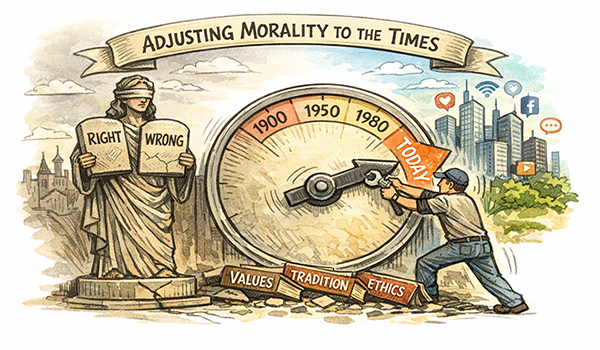
Adjusting Morality To Fit The Changing Times

Adjusting Morality To Fit The Changing Times

Times change. That is a truism. At the same time, it is a statement that is slightly misleading.

Time itself, though very real, is an abstraction. Hence, it cannot act. It has no propulsive force. Times change only because people change. And they change with or without their knowledge or consent. We live in different times because people have directed their lives in different ways.

Time is what gives people the opportunity to change. The transition from the horse and buggy to the automobile required time. But human resourcefulness and human determination accomplished it.

On the other hand, Homo sapiens retains his identity throughout change. He is the continuous thread that underlies all change. He is also subject to the same natural law as the basis for morality.

The times change, but the essential nature of man remains the same. We remain in tune to the literature of Shakespeare, the philosophy of Plato, and the music of Bach. We are attuned to the timeless.

On the subject of euthanasia, the change from 1976, let us say, to the present, 2026, is both extensive and dramatic. We might even refer to it as a cultural metamorphosis.

Dr. Charles E. Rice, in his book, Beyond Abortion, provides us with an account of a conversation between a daughter and her mother that took place in England on Mother’s Day, March 28, 1976. The entire episode was recorded by a hidden police camera. Later, British television included the episode in a documentary that was made available to home viewers.

The recorded conversation between a daughter and her 87-year-old mother, together with its consequences, provides a clear and accurate picture of the status of euthanasia in England at that time.

Sixty-year-old Yolande McShane was urging her mother to end her life. The mother resisted, however, believing that suicide is a cowardly way to end one’s life. “It isn’t cowardly, for goodness sakes,” the daughter said. “If you had a dog in this state, you would take it to the vet, wouldn’t you?” “A dog hasn’t got a soul,” the mother replied. “I’m so afraid of being punished after.” “Oh, Mummy, for this? You wouldn’t be punished for this. . . .”

The daughter then handed her mother a lethal dose of 15 barbiturate tablets and urged her to take them with a “big drink of whiskey” (which is always fatal). The daughter then left the room. As soon as she did, nursing home nuns rushed in and snatched the pills away from the mother just as she was about to take them.

The British court accepted the police film as evidence. Yolande McShane was sentenced to two years in prison for aiding and abetting an attempted suicide. Her motive was allegedly the $70,000 she would inherit on her mother’s death.

While serving time, the mother passed away from natural causes and the daughter received her inheritance.

In Canada, it is expected that in April of this year, 2026, 100,000 Canadians will have perished due to medically assisted euthanasia. And the annual rates of MAiD (Medical Assistance in Dying) continue to increase.

Over the course of 50 years, assistance in euthanasia has changed from being a criminal offense in Great Britain to an established feature of Canadian culture. Such a radical change could not have taken place without the consent of a significant number of people, especially those in high places, who have adjusted their moral outlook to fit the changing times.

Emile Durkheim, a pioneer in the field of sociology, has stated that there is a limit to the amount of aberrant behavior that a society can afford to recognize. He has labeled this the “Durkheim Constant.” When such behavior or attitudes reach a certain point, people adjust and accept it.

This has happened with regard to contraception, divorce, pornography, abortion, and now, euthanasia. What is ignored, as the Durkheim Constant approaches, is a sense of the sanctity of human life which should be the proper constant for any culture.

A study by sociologist William McCready of the National Opinion Research Center suggests that the acceptance of euthanasia is increasing among Catholics who had acquiesced in contraception and abortion.

The phenomenon of “joining the crowd” seems to be at play in this instance. Actions that were once regarded as criminal are now regarded as “rights.” As crimes become rights, the Durkheim Constant is reached and people make their adjustments.

The notion of “death with dignity” has greatly facilitated the acceptance of euthanasia. What is egregiously overlooked, however, is “life with dignity.” That dignity is inseparable from the “sanctity of life.” “Thou shalt not kill” is an imperative that is founded on the sanctity of life. Unfortunately, a preference for convenience has displaced it.

It is of crucial importance that people understand their moral responsibilities in a changing world. To ride the whirlwind is to choose to do nothing, an invidious choice that allows society to continue on its downward slide.

The situation is not hopeless as long as people will struggle and fight for the sanctity of human life. We should not want to be part of a culture which claims that life is not worth living, but death offers us dignity.

There will always be change, but without an unchanging center, it becomes chaos. That center — the sanctity of human life — cannot be compromised.
Adjusting Morality To Fit The Changing Times

Times change. That is a truism. At the same time, it is a statement that is slightly misleading.

Time itself, though very real, is an abstraction. Hence, it cannot act. It has no propulsive force. Times change only because people change. And they change with or without their knowledge or consent. We live in different times because people have directed their lives in different ways.

Time is what gives people the opportunity to change. The transition from the horse and buggy to the automobile required time. But human resourcefulness and human determination accomplished it.

On the other hand, Homo sapiens retains his identity throughout change. He is the continuous thread that underlies all change. He is also subject to the same natural law as the basis for morality.

The times change, but the essential nature of man remains the same. We remain in tune to the literature of Shakespeare, the philosophy of Plato, and the music of Bach. We are attuned to the timeless.

On the subject of euthanasia, the change from 1976, let us say, to the present, 2026, is both extensive and dramatic. We might even refer to it as a cultural metamorphosis.

Dr. Charles E. Rice, in his book, Beyond Abortion, provides us with an account of a conversation between a daughter and her mother that took place in England on Mother’s Day, March 28, 1976. The entire episode was recorded by a hidden police camera. Later, British television included the episode in a documentary that was made available to home viewers.

The recorded conversation between a daughter and her 87-year-old mother, together with its consequences, provides a clear and accurate picture of the status of euthanasia in England at that time.

Sixty-year-old Yolande McShane was urging her mother to end her life. The mother resisted, however, believing that suicide is a cowardly way to end one’s life. “It isn’t cowardly, for goodness sakes,” the daughter said. “If you had a dog in this state, you would take it to the vet, wouldn’t you?” “A dog hasn’t got a soul,” the mother replied. “I’m so afraid of being punished after.” “Oh, Mummy, for this? You wouldn’t be punished for this. . . .”

The daughter then handed her mother a lethal dose of 15 barbiturate tablets and urged her to take them with a “big drink of whiskey” (which is always fatal). The daughter then left the room. As soon as she did, nursing home nuns rushed in and snatched the pills away from the mother just as she was about to take them.

The British court accepted the police film as evidence. Yolande McShane was sentenced to two years in prison for aiding and abetting an attempted suicide. Her motive was allegedly the $70,000 she would inherit on her mother’s death.

While serving time, the mother passed away from natural causes and the daughter received her inheritance.

In Canada, it is expected that in April of this year, 2026, 100,000 Canadians will have perished due to medically assisted euthanasia. And the annual rates of MAiD (Medical Assistance in Dying) continue to increase.

Over the course of 50 years, assistance in euthanasia has changed from being a criminal offense in Great Britain to an established feature of Canadian culture. Such a radical change could not have taken place without the consent of a significant number of people, especially those in high places, who have adjusted their moral outlook to fit the changing times.

Emile Durkheim, a pioneer in the field of sociology, has stated that there is a limit to the amount of aberrant behavior that a society can afford to recognize. He has labeled this the “Durkheim Constant.” When such behavior or attitudes reach a certain point, people adjust and accept it.

This has happened with regard to contraception, divorce, pornography, abortion, and now, euthanasia. What is ignored, as the Durkheim Constant approaches, is a sense of the sanctity of human life which should be the proper constant for any culture.

A study by sociologist William McCready of the National Opinion Research Center suggests that the acceptance of euthanasia is increasing among Catholics who had acquiesced in contraception and abortion.

The phenomenon of “joining the crowd” seems to be at play in this instance. Actions that were once regarded as criminal are now regarded as “rights.” As crimes become rights, the Durkheim Constant is reached and people make their adjustments.

The notion of “death with dignity” has greatly facilitated the acceptance of euthanasia. What is egregiously overlooked, however, is “life with dignity.” That dignity is inseparable from the “sanctity of life.” “Thou shalt not kill” is an imperative that is founded on the sanctity of life. Unfortunately, a preference for convenience has displaced it.

It is of crucial importance that people understand their moral responsibilities in a changing world. To ride the whirlwind is to choose to do nothing, an invidious choice that allows society to continue on its downward slide.

The situation is not hopeless as long as people will struggle and fight for the sanctity of human life. We should not want to be part of a culture which claims that life is not worth living, but death offers us dignity.

There will always be change, but without an unchanging center, it becomes chaos. That center — the sanctity of human life — cannot be compromised.

Times change. That is a truism. At the same time, it is a statement that is slightly misleading. Time itself, though very real, is an abstraction. Hence, it cannot act.

This article is available to E- Edition subscribers only.

Support trusted Catholic journalism by subscribing to The Wanderer.

Subscribe Now

E-Edition

$7/month


  • access All Online Articles.

  • Read the Wanderer print edition and news articles online on your smartphone, tablet, and PC.

  • Your source for weekly Catholic news and commentary. Catholic, conservative, orthodox, and loyal to the Magisterium.


$60 yearly subscription


[leaky_paywall_subscription]

Author’s Archives

By DONALD DEMARCO

Ethics And Language

A language develops in mysterious ways. How it emerges from grunts and groans to the highly complex and intricate web of meaning…

A Bishop Ahead Of His Time

Archbishop John Aloysius Murphy (1905–1995), whose life, like that of St. John Henry Newman (1801–1890), spanned the better part of the century…

A Dozen Roses And A Dozen Thorns

By DR. DONALD DEMARCO We are experiencing a leadership crisis. In Canada, an ineffective prime minister has resigned under pressure. In the…

Clarifying Two Meanings Of Hope

By DONALD DeMARCO We are inescapably creatures of the future. This is why we live in hope. We need a reason to…